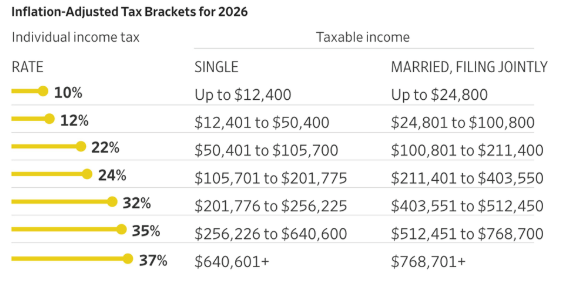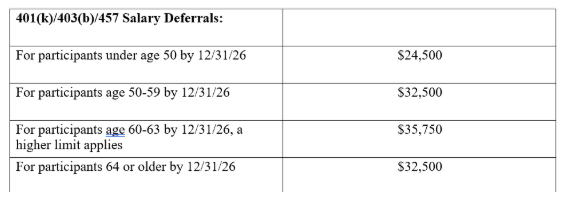
Monthly Archives

December 2025

Can I Automate My Required Minimum Distributions With My Retirement Account Provider?

By Retirement Planning

Required minimum distributions (RMDs) are not well understood, and we would like to clear up some confusion about them. First of all, they cannot be automated, so you are responsible for remembering that they must be taken, by their due dates and in the right amounts from the right accounts. Of course, feel free to reach out to us for more information about your personal situation. We are here to help!

The Basics About RMDs

1) RMDs are not automatic, and not all institutions or custodians provide reminders. Retirees must proactively remember to take RMDs.

2) You must take RMDs from all your traditional (non-Roth) qualified accounts annually, including IRAs, 401(k) plans, 403(b) plans, 457(b) plans, TSPs, SEP IRAs, SIMPLE IRAs and similar types of accounts.

3) The deadline for RMDs is December 31 each year, not April 15. Missing the deadline can come with a 25% excise penalty along with income taxes owed.

4) For clients taking their very first RMD, the distribution must be taken by April 1 of the year following the calendar year in which they reach age 73.

5) Required minimum distributions are subject to ordinary income taxes and are added to your combined income (sometimes called provisional income) for Social Security tax purposes.

6) The first dollars you withdraw from taxable retirement accounts in any given year are considered RMDs. This is important to remember if you decide to do Roth conversions.

7) Depending on type, there are different rules regarding taking a percentage of the aggregated amount held in multiple qualified accounts, versus requiring separate withdrawals from each different account. For instance:

a) You can generally aggregate your traditional (non-Roth) IRA account amounts and withdraw the total amount due from one of your IRAs.

b) For 401(k) and 457(b) accounts, you must calculate and withdraw RMD money separately from each individual account that you own. (This is why some retirees choose to roll over accounts for simplicity.)

c) For 403(b) plans, you can aggregate amounts in all your 403(b)s, but you can’t aggregate those amounts with other types of accounts that you own, such as IRAs or 401(k)s.

d) Spouses cannot aggregate their accounts. Each spouse must take RMDs separately from their own accounts.

e) For inherited IRAs, RMDs can only be aggregated with other inherited IRAs if they were inherited from the same original owner.

8) Miscalculated amounts, late RMDs, or withdrawals taken from the wrong accounts often come with a 25% excise tax on top of income taxes owed.

9) The SECURE Act, which took effect January 1, 2020, changed RMD rules significantly, and many people who inherit taxable qualified accounts are still unaware of how this affects them. Non-spousal heirs must take RMDs, and empty inherited accounts completely within 10 years of inheritance. Surviving spouses must take RMDs, too. The IRS uses several tables to calculate RMD amounts owed.

10) If you give to charity, you can often directly distribute all or part of your RMD to your chosen nonprofit, reducing your taxable income by that amount. These are called qualified charitable distributions (QCDs). But there is a caveat. Some financial institutions don’t break down or delineate that your distribution was a charitable contribution—they just send you a 1099. It is critical for you to make sure these amounts are deducted rather than added to your tax return!

A recent breakdown of the most common (and surprising!) RMD mistakes revealed just how easy it is for retirees to make costly errors. We can partner with your tax advisors to make a plan for your future RMDs, potentially finding ways to mitigate your tax burden. Give us a call today and understand your options before you need them! You can reach BayTrust Financial in Tampa at 813.820.0069.


This article is for general information purposes only from sources believed to be accurate. It should not be construed as tax advice. In every case, you should consult with your own personal team of tax, financial, and legal advisors for tax advice specific to your own personal financial situation.

Sources:

https://www.financialadvisoriq.com/c/4991394/692364/affluent_investors_want_planning_cerulli

https://insights.smartasset.com/7-of-the-biggest-rmd-mistakes-people-make

https://www.thinkadvisor.com/2025/09/23/the-worst-rmd-mistakes-clients-made-advisors-advice/

https://www.irs.gov/retirement-plans/plan-participant-employee/retirement-topics-required-minimum-distributions-rmds


Mitch Zacks – Weekly Market Commentary: The Story Isn’t the Rate Cut, It’s What Comes Next

By Weekly Market Commentary

The Federal Reserve delivered another 25-basis point rate cut at its December meeting, bringing the federal-funds range down to 3.50% to 3.75%. I would argue that the markets had priced in the outcome for weeks, and most investors already viewed it as a continuation of the Fed’s gradual effort to transition from “restrictive” toward something closer to neutral.1

The data heading into the meeting gave the Fed enough cover to ease, in my view. The latest inflation update, the September PCE report2, showed core prices rising 0.2% month-over-month and 2.8% year-over-year. Those aren’t perfect numbers, but they’re stable, and importantly, not accelerating meaningfully despite tariff pressure.

The labor market, meanwhile, has been showing signs of moderating but not collapsing. The most recent JOLTS3 report from the Bureau of Labor Statistics showed job openings easing to roughly 8.8 million, with quits rates drifting down—signs that both workers and employers are hanging tight. Employers are not on hiring or firing sprees, and workers are not switching jobs at a high rate. In short, there’s balance in the labor market, but it may be softer than what the Fed wants to see.

At the end of the day, concerns about the labor market appeared to outweigh concerns over inflation making downward progress towards the 2% target. Fed officials were divided over these two factors, but the compromise was what appeared to be a “cut-and-cap” approach: deliver the rate cut now, but make it clear that the bar for further easing is higher from here. That was my read from Chairman Powell’s posturing after the meeting.

In terms of where we go from here, investors often overestimate the economic impact of a quarter-point adjustment in the fed funds rate. Few long-term business projects suddenly become viable because the policy rate moves 25 bps lower. And markets also tend to price in anticipated Fed actions ahead of time, with mortgage, auto, and business-loan rates rarely moving one-for-one with the Fed.

Still, saying the impact is limited doesn’t mean it’s zero.

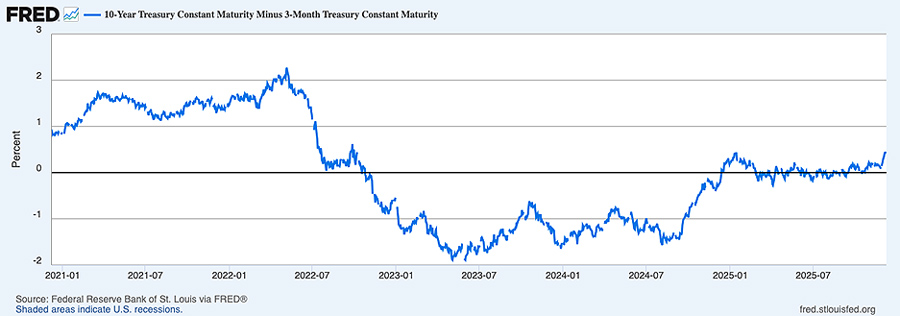
The first area where rate cuts can help is the yield curve, which has been flat for an unusually long stretch. While the curve has steepened slightly in recent months (see chart below), it remains close to flat. Lowering short-term rates generally encourages some natural steepening, which historically supports forward economic growth.

Source: Federal Reserve Bank of St. Louis4

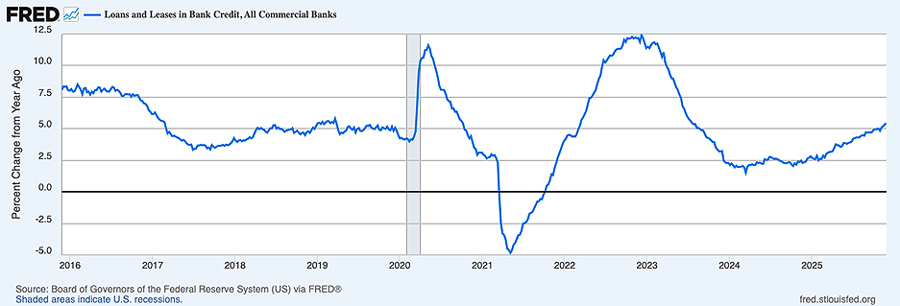
The second area is bank lending, where the backdrop is already healthier than headlines imply. Growth in loans and leases has improved meaningfully over the past year, as seen on the chart below. Part of this comes down to simple economics. The average savings deposit rate at banks today is roughly 0.4%, while long-term lending rates—mortgages, commercial loans, consumer credit—are several percentage points higher. That spread gives banks strong incentives to lend, and a modest rate cut only reinforces that dynamic.

Source: Federal Reserve Bank of St. Louis5

Taken together, I think this modest rate cut will help at the margin, but I would not frame it as a catalyst that will all of a sudden drive a surge in economic activity. The economy is in relatively fine shape, and already being supported by steady lending, improving real wage trends, and corporate earnings that continue to exceed the more pessimistic forecasts from earlier this year. 25-basis points is not likely to move the needle dramatically, in my view.

Bottom Line for Investors

Investors often look to Fed decisions for clarity, but the more important takeaway from this meeting is what hasn’t changed, in my view. The expansion remains intact, even if it is slower and more uneven beneath the surface. A small rate cut is not going to change the economic narrative, but it may add a tailwind at a time when credit creation and corporate fundamentals still provide a reasonable foundation for continued growth. The Fed’s shift toward a “cut-and-cap” posture simply returns the focus to data rather than expectations, which is exactly where long-term investors should keep their focus as well.

Wall Street Journal. December 9, 2025. https://advisor.zacksim.com/e/376582/-cut-ef7118b8-mod-hp-lead-pos5/5tx571/1410802305/h/ZyUzHu-s3Ip9AAT83WrhDvgFCNCQXIyzPqdQDIIIkkA

CNBC. December 5, 2025. https://advisor.zacksim.com/e/376582/ion-report-september-2025-html/5tx574/1410802305/h/ZyUzHu-s3Ip9AAT83WrhDvgFCNCQXIyzPqdQDIIIkkA

BLS. 2025. https://advisor.zacksim.com/e/376582/news-release-jolts-nr0-htm/5tx577/1410802305/h/ZyUzHu-s3Ip9AAT83WrhDvgFCNCQXIyzPqdQDIIIkkA

Fred Economic Data. December 5, 2025. https://advisor.zacksim.com/e/376582/series-TOTLL/5tx57b/1410802305/h/ZyUzHu-s3Ip9AAT83WrhDvgFCNCQXIyzPqdQDIIIkkA

Fred Economic Data. December 5, 2025. https://advisor.zacksim.com/e/376582/series-TOTLL/5tx57b/1410802305/h/ZyUzHu-s3Ip9AAT83WrhDvgFCNCQXIyzPqdQDIIIkkA

DISCLOSURE
Past performance is no guarantee of future results. Inherent in any investment is the potential for loss.

Zacks Investment Management, Inc. is a wholly-owned subsidiary of Zacks Investment Research. Zacks Investment Management is an independent Registered Investment Advisory firm and acts as an investment manager for individuals and institutions. Zacks Investment Research is a provider of earnings data and other financial data to institutions and to individuals.

This material is being provided for informational purposes only and nothing herein constitutes investment, legal, accounting or tax advice, or a recommendation to buy, sell or hold a security. Do not act or rely upon the information and advice given in this publication without seeking the services of competent and professional legal, tax, or accounting counsel. Publication and distribution of this article is not intended to create, and the information contained herein does not constitute, an attorney-client relationship. No recommendation or advice is being given as to whether any investment or strategy is suitable for a particular investor. It should not be assumed that any investments in securities, companies, sectors or markets identified and described were or will be profitable. All information is current as of the date of herein and is subject to change without notice. Any views or opinions expressed may not reflect those of the firm as a whole.

Any projections, targets, or estimates in this report are forward looking statements and are based on the firm’s research, analysis, and assumptions. Due to rapidly changing market conditions and the complexity of investment decisions, supplemental information and other sources may be required to make informed investment decisions based on your individual investment objectives and suitability specifications. All expressions of opinions are subject to change without notice. Clients should seek financial advice regarding the appropriateness of investing in any security or investment strategy discussed in this presentation.

Certain economic and market information contained herein has been obtained from published sources prepared by other parties.  Zacks Investment Management does not assume any responsibility for the accuracy or completeness of such information. Further, no third party has assumed responsibility for independently verifying the information contained herein and accordingly no such persons make any representations with respect to the accuracy, completeness or reasonableness of the information provided herein. Unless otherwise indicated, market analysis and conclusions are based upon opinions or assumptions that Zacks Investment Management considers to be reasonable. Any investment inherently involves a high degree of risk, beyond any specific risks discussed herein.

The S&P 500 Index is a well-known, unmanaged index of the prices of 500 large-company common stocks, mainly blue-chip stocks, selected by Standard & Poor’s. The S&P 500 Index assumes reinvestment of dividends but does not reflect advisory fees. The volatility of the benchmark may be materially different from the individual performance obtained by a specific investor. An investor cannot invest directly in an index.

The Russell 1000 Growth Index is a well-known, unmanaged index of the prices of 1000 large-company growth common stocks selected by Russell. The Russell 1000 Growth Index assumes reinvestment of dividends but does not reflect advisory fees. An investor cannot invest directly in an index. The volatility of the benchmark may be materially different from the individual performance obtained by a specific investor.

Nasdaq Composite Index is the market capitalization-weighted index of over 3,300 common equities listed on the Nasdaq stock exchange. The types of securities in the index include American depositary receipts, common stocks, real estate investment trusts (REITs) and tracking stocks, as well as limited partnership interests. The index includes all Nasdaq-listed stocks that are not derivatives, preferred shares, funds, exchange-traded funds (ETFs) or debenture securities. An investor cannot invest directly in an index. The volatility of the benchmark may be materially different from the individual performance obtained by a specific investor.
The Dow Jones Industrial Average measures the daily stock market movements of 30 U.S. publicly-traded companies listed on the NASDAQ or the New York Stock Exchange (NYSE). The 30 publicly-owned companies are considered leaders in the United States economy. An investor cannot directly invest in an index.  The volatility of the benchmark may be materially different from the individual performance obtained by a specific investor.
The Bloomberg Global Aggregate Index is a flagship measure of global investment grade debt from twenty-four local currency markets. This multi-currency benchmark includes treasury, government-related, corporate and securitized fixed-rate bonds from both developed and emerging markets issuers. An investor cannot invest directly in an index. The volatility of the benchmark may be materially different from the individual performance obtained by a specific investor.
The ICE Exchange-Listed Fixed & Adjustable Rate Preferred Securities Index is a modified market capitalization weighted index composed of preferred stock and securities that are functionally equivalent to preferred stock including, but not limited to, depositary preferred securities, perpetual subordinated debt and certain securities issued by banks and other financial institutions that are eligible for capital treatment with respect to such instruments akin to that received for issuance of straight preferred stock. An investor cannot invest directly in an index. The volatility of the benchmark may be materially different from the individual performance obtained by a specific investor.
The MSCI ACWI ex U.S. Index captures large and mid-cap representation across 22 of 23 Developed Markets (DM) countries (excluding the United States) and 24 Emerging Markets (EM) countries. The index covers approximately 85% of the global equity opportunity set outside the U.S. An investor cannot invest directly in an index. The volatility of the benchmark may be materially different from the individual performance obtained by a specific investor.
The Russell 2000 Index is a well-known, unmanaged index of the prices of 2000 small-cap company common stocks, selected by Russell. The Russell 2000 Index assumes reinvestment of dividends but does not reflect advisory fees. An investor cannot invest directly in an index. The volatility of the benchmark may be materially different from the individual performance obtained by a specific investor.

The S&P Mid Cap 400 provides investors with a benchmark for mid-sized companies. The index, which is distinct from the large-cap S&P 500, is designed to measure the performance of 400 mid-sized companies, reflecting the distinctive risk and return characteristics of this market segment.

The S&P 500 Pure Value index is a style-concentrated index designed to track the performance of stocks that exhibit the strongest value characteristics by using a style-attractiveness-weighting scheme. An investor cannot directly invest in an index.  The volatility of the benchmark may be materially different from the individual performance obtained by a specific investor.

Mitch Zacks – Weekly Market Commentary: How AI Spending is Lifting U.S. Economic Growth, and What That Means for Investors

By Weekly Market Commentary

There is little question about the impact the artificial intelligence boom is having on S&P 500 earnings and total return.1 According to my colleagues at Zacks Investment Research, the “Magnificent 7” group of mega-cap technology stocks is on track to bring in 26% of all S&P 500 earnings this year, up from 23.2% of the total in 2024 and 11.7% in 2019. The group also made up roughly 35% of the index as of the end of the third quarter.2

But what about the impact the AI spending boom is having on the U.S. economy?

In short, it’s been significant.

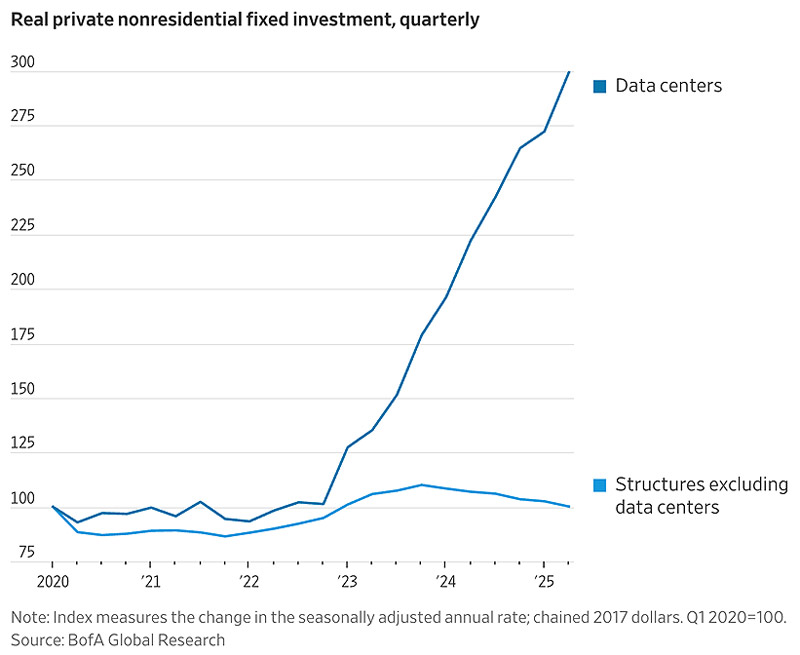
By some estimates, first-half 2025 GDP growth was substantially powered by spending on data centers, information-processing equipment, and software. Excluding these categories, economic growth would have been more modest. To grasp the scale of AI’s impact, consider that the dollar value of AI data-center investment has exceeded total consumer-spending contributions to GDP in 2025. The chart below also demonstrates data centers’ contribution to total fixed private investment. It’s pretty remarkable.

Wall Street Journal3

Without the lift from AI capex, economic growth may have been more modest, closer to 1.5% perhaps, in the first half. Growth is growth, but I think it’s a fair argument to frame the broader economy’s performance as more ‘steady’ than ‘booming.’ The impact of AI spending doesn’t dilute growth elsewhere, it just moves the needle in the booming direction.

Outside of the AI theme, investors can find soft patches in the economy. Retail sales in September (delayed due to the shutdown) rose just 0.2%, with noticeable pullbacks in tariff-sensitive categories such as vehicles, electronics, and clothing.4 Spending on services remained firm, however, which suggests consumers are still spending selectively and with more emphasis on value. It’s a pattern consistent with an expansion that continues, but with less broad-based momentum.

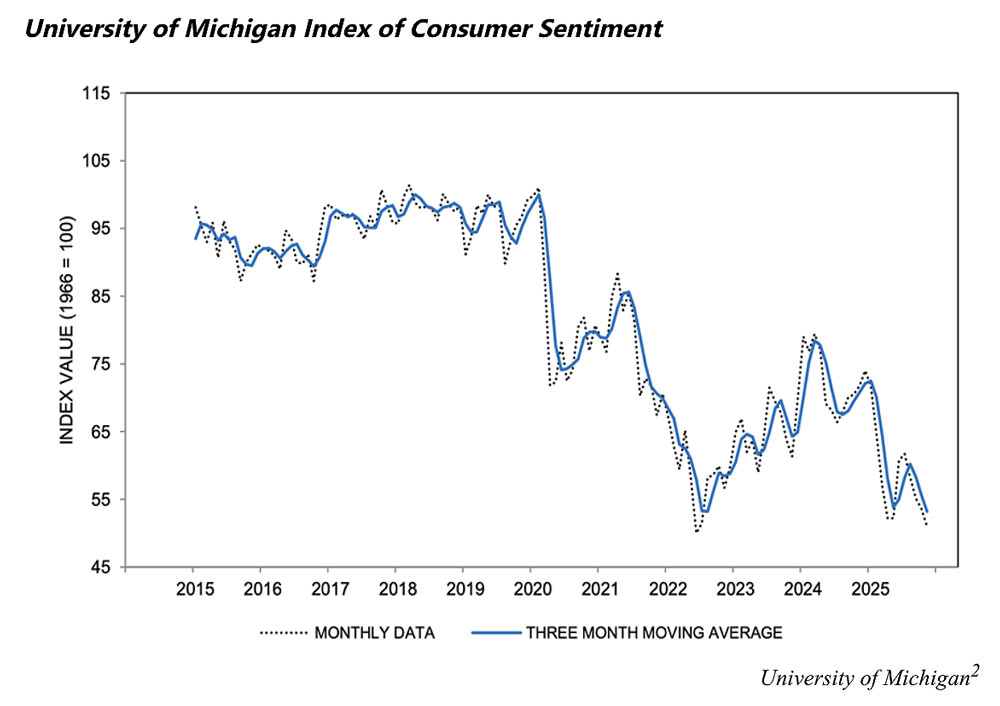
Sentiment surveys show similar nuance. The Conference Board’s confidence index fell in November to 88.7 from 95.5, while the share of households reporting plentiful job opportunities also stepped down. The University of Michigan’s survey has hovered near historical lows for months. As I wrote in a recent column, I think this is symptomatic of a “K-shaped” economy, which is relying more on high-income consumers and wealth effects than on job creation or broad wage gains. This is not a negative setup, it’s just a read on where the economy largely is today.

Does this all mean that a slowdown in AI spending would cause an economic downturn by itself? At this moment, I don’t think so. But I think it could meaningfully trim the growth rate, such that the U.S. economy would be posting more modest growth than the 2% to 3% headline rate that signals overall strength. This possibility does not suggest crouching in defensive mode and waiting for AI spending to pullback substantially—it argues for positioning in solid companies with earnings growth momentum outside of the AI trade.

Bottom Line for Investors

I think it’s clear that AI spending has provided a boost to headline GDP this year. When you strip out the sizable capex numbers, what you see is a modestly positive expansion versus a boom. I want to be clear—this is not a bad backdrop for long-term investors. But it does leave the cycle more sensitive to a potential shift from a single, powerful growth engine (AI capex).

I think that’s the real takeaway here. The economy is in fine shape, but it’s more dependent on one theme than usual. If AI investment keeps flowing, the expansion can keep chugging along. If it downshifts, the underlying modest growth pace may become more visible. Rather than trying to forecast when or if that happens, investors are better served maintaining balance across sectors, styles, and regions so portfolios aren’t tethered to any one story. If AI capex deflates, I could see assets rotating into under-valued areas of the market that are still seeing strong earnings growth.

Wall Street Journal. November 24, 2025. https://advisor.zacksim.com/e/376582/ng-4b6bc7ff-mod-article-inline/5twbjh/1402707083/h/Xd24NqpfuxBTxb20ypIcpZPxo_W4o4kOOMs0GnDkLxY

Zacks.com. November 22, 2025. https://advisor.zacksim.com/e/376582/outlook-improves-a-closer-look/5twbjl/1402707083/h/Xd24NqpfuxBTxb20ypIcpZPxo_W4o4kOOMs0GnDkLxY

Wall Street Journal. November 21, 2025. https://advisor.zacksim.com/e/376582/ng-4b6bc7ff-mod-article-inline/5twbjh/1402707083/h/Xd24NqpfuxBTxb20ypIcpZPxo_W4o4kOOMs0GnDkLxY

Wall Street Journal. November 25, 2025. https://advisor.zacksim.com/e/376582/ons-536756d2-mod-hp-lead-pos11/5twbjp/1402707083/h/Xd24NqpfuxBTxb20ypIcpZPxo_W4o4kOOMs0GnDkLxY

DISCLOSURE
Past performance is no guarantee of future results. Inherent in any investment is the potential for loss.

Zacks Investment Management, Inc. is a wholly-owned subsidiary of Zacks Investment Research. Zacks Investment Management is an independent Registered Investment Advisory firm and acts as an investment manager for individuals and institutions. Zacks Investment Research is a provider of earnings data and other financial data to institutions and to individuals.

This material is being provided for informational purposes only and nothing herein constitutes investment, legal, accounting or tax advice, or a recommendation to buy, sell or hold a security. Do not act or rely upon the information and advice given in this publication without seeking the services of competent and professional legal, tax, or accounting counsel. Publication and distribution of this article is not intended to create, and the information contained herein does not constitute, an attorney-client relationship. No recommendation or advice is being given as to whether any investment or strategy is suitable for a particular investor. It should not be assumed that any investments in securities, companies, sectors or markets identified and described were or will be profitable. All information is current as of the date of herein and is subject to change without notice. Any views or opinions expressed may not reflect those of the firm as a whole.

Any projections, targets, or estimates in this report are forward looking statements and are based on the firm’s research, analysis, and assumptions. Due to rapidly changing market conditions and the complexity of investment decisions, supplemental information and other sources may be required to make informed investment decisions based on your individual investment objectives and suitability specifications. All expressions of opinions are subject to change without notice. Clients should seek financial advice regarding the appropriateness of investing in any security or investment strategy discussed in this presentation.

Certain economic and market information contained herein has been obtained from published sources prepared by other parties.  Zacks Investment Management does not assume any responsibility for the accuracy or completeness of such information. Further, no third party has assumed responsibility for independently verifying the information contained herein and accordingly no such persons make any representations with respect to the accuracy, completeness or reasonableness of the information provided herein. Unless otherwise indicated, market analysis and conclusions are based upon opinions or assumptions that Zacks Investment Management considers to be reasonable. Any investment inherently involves a high degree of risk, beyond any specific risks discussed herein.

The S&P 500 Index is a well-known, unmanaged index of the prices of 500 large-company common stocks, mainly blue-chip stocks, selected by Standard & Poor’s. The S&P 500 Index assumes reinvestment of dividends but does not reflect advisory fees. The volatility of the benchmark may be materially different from the individual performance obtained by a specific investor. An investor cannot invest directly in an index.

The Russell 1000 Growth Index is a well-known, unmanaged index of the prices of 1000 large-company growth common stocks selected by Russell. The Russell 1000 Growth Index assumes reinvestment of dividends but does not reflect advisory fees. An investor cannot invest directly in an index. The volatility of the benchmark may be materially different from the individual performance obtained by a specific investor.

Nasdaq Composite Index is the market capitalization-weighted index of over 3,300 common equities listed on the Nasdaq stock exchange. The types of securities in the index include American depositary receipts, common stocks, real estate investment trusts (REITs) and tracking stocks, as well as limited partnership interests. The index includes all Nasdaq-listed stocks that are not derivatives, preferred shares, funds, exchange-traded funds (ETFs) or debenture securities. An investor cannot invest directly in an index. The volatility of the benchmark may be materially different from the individual performance obtained by a specific investor.

The Dow Jones Industrial Average measures the daily stock market movements of 30 U.S. publicly-traded companies listed on the NASDAQ or the New York Stock Exchange (NYSE). The 30 publicly-owned companies are considered leaders in the United States economy. An investor cannot directly invest in an index.  The volatility of the benchmark may be materially different from the individual performance obtained by a specific investor.

The Bloomberg Global Aggregate Index is a flagship measure of global investment grade debt from twenty-four local currency markets. This multi-currency benchmark includes treasury, government-related, corporate and securitized fixed-rate bonds from both developed and emerging markets issuers. An investor cannot invest directly in an index. The volatility of the benchmark may be materially different from the individual performance obtained by a specific investor.

The ICE Exchange-Listed Fixed & Adjustable Rate Preferred Securities Index is a modified market capitalization weighted index composed of preferred stock and securities that are functionally equivalent to preferred stock including, but not limited to, depositary preferred securities, perpetual subordinated debt and certain securities issued by banks and other financial institutions that are eligible for capital treatment with respect to such instruments akin to that received for issuance of straight preferred stock. An investor cannot invest directly in an index. The volatility of the benchmark may be materially different from the individual performance obtained by a specific investor.

The MSCI ACWI ex U.S. Index captures large and mid-cap representation across 22 of 23 Developed Markets (DM) countries (excluding the United States) and 24 Emerging Markets (EM) countries. The index covers approximately 85% of the global equity opportunity set outside the U.S. An investor cannot invest directly in an index. The volatility of the benchmark may be materially different from the individual performance obtained by a specific investor.

The Russell 2000 Index is a well-known, unmanaged index of the prices of 2000 small-cap company common stocks, selected by Russell. The Russell 2000 Index assumes reinvestment of dividends but does not reflect advisory fees. An investor cannot invest directly in an index. The volatility of the benchmark may be materially different from the individual performance obtained by a specific investor.

The S&P Mid Cap 400 provides investors with a benchmark for mid-sized companies. The index, which is distinct from the large-cap S&P 500, is designed to measure the performance of 400 mid-sized companies, reflecting the distinctive risk and return characteristics of this market segment.

The S&P 500 Pure Value index is a style-concentrated index designed to track the performance of stocks that exhibit the strongest value characteristics by using a style-attractiveness-weighting scheme. An investor cannot directly invest in an index.  The volatility of the benchmark may be materially different from the individual performance obtained by a specific investor.

Mitch Zacks – Weekly Market Commentary: The “K-Shaped” U.S. Consumer Landscape

By Weekly Market Commentary

In looking closely at the U.S. consumer, I see 2025 shaping up to resemble the “K-shaped” pattern we saw earlier in the decade. The “K” refers to higher-income households continuing to spend comfortably, while lower- and middle-income consumers show more strain and even pull back from certain categories of purchases.

This divergence matters for investors, but not because it signals an imminent recession. Instead, it helps explain the mix of economic data we’re seeing at a time when broad sentiment continues to sink.1

Recent shutdown-delayed data showed retail sales slowing toward the end of the third quarter, rising just 0.2% in September. Categories tied closely to tariffs, such as vehicles, electronics, and clothing, all showed noticeable pullbacks. But there were also bright spots, with service-oriented spending, particularly in restaurants and personal care, remaining firm. This data reinforces the argument that we’re in a “K-shaped” consumer environment, where different income groups are spending in different directions.

On the sentiment side, the Conference Board’s confidence reading dropped sharply in November to 88.7 from 95.5, and the University of Michigan’s survey fell to 51 (see chart below). That’s one of the lowest readings for consumer sentiment on record. In that same survey, 44% of middle-income households said their financial situation was worse than a year ago, compared with just 23% who said it had improved. U.S. households have been weary of higher prices for years, but we might be starting to see a wider group ‘throwing in the towel’, especially those who expected prices to reverse under the new administration.

Lower- and middle-income households have been the most affected by higher living costs, depleted savings, and a cooling labor market. The ADP reported that private employers shed an average of 13,500 jobs per week in the four weeks ending November 8. That sort of softening understandably weighs on sentiment.

But the other side of the “K-shaped” ledger shows higher-income households continuing to show much more resilience. Spending in discretionary service categories rose 0.7% in September, and wealth effects remain meaningful. Household net worth has surged in recent quarters, rising at nearly a 15% annualized rate, which has acted as an important counterweight to softer job creation. Even with frustrations about inflation, this level of wealth growth historically supports consumer spending for some time.

The divide is showing up clearly in behavior.

Many households at the lower and middle end of the income spectrum are trading down, hunting for value, and cutting discretionary purchases. Some surveys show the middle class reporting near-decade lows in financial comfort, despite relatively stable employment. Meanwhile, the upper-tier consumer, who accounts for a disproportionately large share of overall U.S. consumption, has continued to spend. On balance, it’s been enough to keep the broader economy moving forward.

This brings up an important acknowledgment investors should make, and also be watching closely: consumer sentiment has become sensitive to market swings. The S&P 500’s roughly 5% pullback from late October highs coincided with a noticeable dip in upper-income sentiment surveys. But when markets strengthen, confidence tends to rise as well.

Taken together, these dynamics matter for investors because they help explain why consumer data can appear mixed without signaling recession. A softening labor market, persistent inflation pressures, and fading confidence among lower earners are all legitimate concerns. But as long as employment continues to grow modestly, wealth effects remain supportive, and higher-income households continue to spend, the overall expansion can persist, even if it feels uneven on the ground.

Bottom Line for Investors

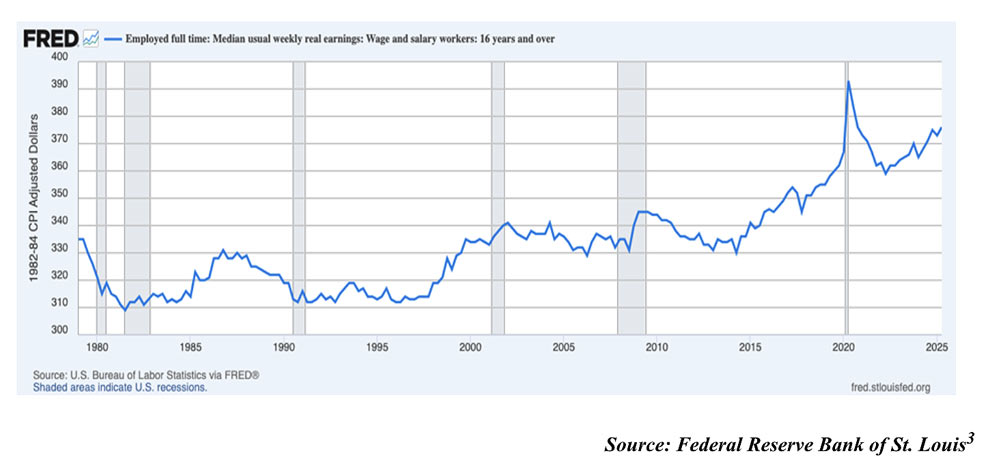
A “K-shaped” U.S. consumer environment is not synonymous with a weakening economy. Many consumers are feeling pressure, but it’s also true that we’re still seeing upward movement in real wages (see chart below). I take this to mean that consumers broadly are feeling frustrated, but they’re not retrenching.

That said, the expansion is increasingly reliant on those with the healthiest balance sheets. Higher-income households continue to spend because equity gains, rising home values, and strong net-worth growth give them the capacity to do so. This helps offset softness elsewhere and has been a stabilizing force.

But it also highlights a key vulnerability. When spending becomes concentrated at the top, the economy becomes more sensitive to anything that chips away at wealth effects. A deeper equity-market pullback, a cooling in housing, or an AI-related shift in white-collar labor demand could have an outsized impact on the very group carrying overall consumption.

For now, the expansion appears durable, supported by ongoing job creation, real wage gains, and strong household balance sheets at the upper end. But the reliance on those dynamics is exactly why investors should stay attuned to them. Because if they begin to turn, the broader economy may feel it more quickly than usual.

Sources:

Wall Street Journal. November 24, 2025. https://advisor.zacksim.com/e/376582/36756d2-mod-economy-lead-story/5tvhp8/1393518193/h/KJKzQMvgS0fGlD3cEpUGfIfgGE8OQ-b9JSI00gZJdU8

University of Michigan. 2025.

Fred Economic Data. July 22, 2025. https://advisor.zacksim.com/e/376582/series-LES1252881600Q/5tvhpc/1393518193/h/KJKzQMvgS0fGlD3cEpUGfIfgGE8OQ-b9JSI00gZJdU8 ​​​​​​

DISCLOSURE
Past performance is no guarantee of future results. Inherent in any investment is the potential for loss.

Zacks Investment Management, Inc. is a wholly-owned subsidiary of Zacks Investment Research. Zacks Investment Management is an independent Registered Investment Advisory firm and acts as an investment manager for individuals and institutions. Zacks Investment Research is a provider of earnings data and other financial data to institutions and to individuals.

This material is being provided for informational purposes only and nothing herein constitutes investment, legal, accounting or tax advice, or a recommendation to buy, sell or hold a security. Do not act or rely upon the information and advice given in this publication without seeking the services of competent and professional legal, tax, or accounting counsel. Publication and distribution of this article is not intended to create, and the information contained herein does not constitute, an attorney-client relationship. No recommendation or advice is being given as to whether any investment or strategy is suitable for a particular investor. It should not be assumed that any investments in securities, companies, sectors or markets identified and described were or will be profitable. All information is current as of the date of herein and is subject to change without notice. Any views or opinions expressed may not reflect those of the firm as a whole.

Any projections, targets, or estimates in this report are forward looking statements and are based on the firm’s research, analysis, and assumptions. Due to rapidly changing market conditions and the complexity of investment decisions, supplemental information and other sources may be required to make informed investment decisions based on your individual investment objectives and suitability specifications. All expressions of opinions are subject to change without notice. Clients should seek financial advice regarding the appropriateness of investing in any security or investment strategy discussed in this presentation.

Certain economic and market information contained herein has been obtained from published sources prepared by other parties.  Zacks Investment Management does not assume any responsibility for the accuracy or completeness of such information. Further, no third party has assumed responsibility for independently verifying the information contained herein and accordingly no such persons make any representations with respect to the accuracy, completeness or reasonableness of the information provided herein. Unless otherwise indicated, market analysis and conclusions are based upon opinions or assumptions that Zacks Investment Management considers to be reasonable. Any investment inherently involves a high degree of risk, beyond any specific risks discussed herein.

The S&P 500 Index is a well-known, unmanaged index of the prices of 500 large-company common stocks, mainly blue-chip stocks, selected by Standard & Poor’s. The S&P 500 Index assumes reinvestment of dividends but does not reflect advisory fees. The volatility of the benchmark may be materially different from the individual performance obtained by a specific investor. An investor cannot invest directly in an index.

The Russell 1000 Growth Index is a well-known, unmanaged index of the prices of 1000 large-company growth common stocks selected by Russell. The Russell 1000 Growth Index assumes reinvestment of dividends but does not reflect advisory fees. An investor cannot invest directly in an index. The volatility of the benchmark may be materially different from the individual performance obtained by a specific investor.

Nasdaq Composite Index is the market capitalization-weighted index of over 3,300 common equities listed on the Nasdaq stock exchange. The types of securities in the index include American depositary receipts, common stocks, real estate investment trusts (REITs) and tracking stocks, as well as limited partnership interests. The index includes all Nasdaq-listed stocks that are not derivatives, preferred shares, funds, exchange-traded funds (ETFs) or debenture securities. An investor cannot invest directly in an index. The volatility of the benchmark may be materially different from the individual performance obtained by a specific investor.

The Dow Jones Industrial Average measures the daily stock market movements of 30 U.S. publicly-traded companies listed on the NASDAQ or the New York Stock Exchange (NYSE). The 30 publicly-owned companies are considered leaders in the United States economy. An investor cannot directly invest in an index.  The volatility of the benchmark may be materially different from the individual performance obtained by a specific investor.

The Bloomberg Global Aggregate Index is a flagship measure of global investment grade debt from twenty-four local currency markets. This multi-currency benchmark includes treasury, government-related, corporate and securitized fixed-rate bonds from both developed and emerging markets issuers. An investor cannot invest directly in an index. The volatility of the benchmark may be materially different from the individual performance obtained by a specific investor.

The ICE Exchange-Listed Fixed & Adjustable Rate Preferred Securities Index is a modified market capitalization weighted index composed of preferred stock and securities that are functionally equivalent to preferred stock including, but not limited to, depositary preferred securities, perpetual subordinated debt and certain securities issued by banks and other financial institutions that are eligible for capital treatment with respect to such instruments akin to that received for issuance of straight preferred stock. An investor cannot invest directly in an index. The volatility of the benchmark may be materially different from the individual performance obtained by a specific investor.

The MSCI ACWI ex U.S. Index captures large and mid-cap representation across 22 of 23 Developed Markets (DM) countries (excluding the United States) and 24 Emerging Markets (EM) countries. The index covers approximately 85% of the global equity opportunity set outside the U.S. An investor cannot invest directly in an index. The volatility of the benchmark may be materially different from the individual performance obtained by a specific investor.

The Russell 2000 Index is a well-known, unmanaged index of the prices of 2000 small-cap company common stocks, selected by Russell. The Russell 2000 Index assumes reinvestment of dividends but does not reflect advisory fees. An investor cannot invest directly in an index. The volatility of the benchmark may be materially different from the individual performance obtained by a specific investor.

The S&P Mid Cap 400 provides investors with a benchmark for mid-sized companies. The index, which is distinct from the large-cap S&P 500, is designed to measure the performance of 400 mid-sized companies, reflecting the distinctive risk and return characteristics of this market segment.

The S&P 500 Pure Value index is a style-concentrated index designed to track the performance of stocks that exhibit the strongest value characteristics by using a style-attractiveness-weighting scheme. An investor cannot directly invest in an index.  The volatility of the benchmark may be materially different from the individual performance obtained by a specific investor.