

Monthly Archives

February 2026

Mitch Zacks – Weekly Market Commentary: Why I Think Investors Should Feel Good About January Economic Data

By Weekly Market Commentary

After several months of parsing through incomplete data sets tied to the government shutdown, we finally received a clean January print with complete inflation and jobs numbers. Investors should be encouraged by what they see, but not because the data showed the economy is booming. Instead, what we see is that the balance of risks appears to be shifting.1

Let’s start with jobs. January payrolls rose by 130,000, and the unemployment rate ticked down to 4.3%. On the surface, that looks like stabilization in the labor market, which is welcome news. But it’s not actually the reason I think investors should feel upbeat. The more consequential part of the jobs report was what it told us about 2025.

Annual benchmark revisions and adjustments to the Bureau of Labor Statistics’ business formation model substantially altered 2025’s hiring picture. What markets and the Federal Reserve largely treated as a reasonably healthy year for job growth was revised down to roughly 180,000 total jobs for the entire year, or an average of just 15,000 per month. Outside of recessions, that ranks among the weakest hiring environments since World War II.

I want to be clear that I’m not implying an under-appreciated jobs market collapse. U.S. employers are not broadly cutting payrolls, and initial jobless claims remain historically low. But job openings have fallen meaningfully from their 2022 peak, quits have declined, and hiring momentum has narrowed dramatically. For instance, nearly all of January’s gains came from healthcare-related fields, which is a sector supported by demographics rather than cyclical strength. Professional services, finance, retail, information, and segments of government payrolls have either stagnated or contracted over the past year.

In other words, the labor market has been quietly cooling for some time, and it’s been cooling while the Federal Reserve has remained overwhelmingly focused on inflation. This is an important point, especially when you consider the January inflation report.

The latest CPI reading showed headline inflation slowing to 2.4% year over year, down from 2.7% in December. Core CPI came in at 2.5%, the lowest since the post-pandemic inflation surge began in 2021. Shelter costs, which had been the single largest contributor to elevated inflation, rose just 0.2% month over month and continue to trend lower on a year-over-year basis.

There are still areas of stickiness, and the Fed’s preferred PCE measure is still running closer to 3% than 2%. But the feared reacceleration of inflation has simply not materialized. After several years in which early-year data disrupted the disinflation story, January 2026 did not bring that setback.

Taken together, the revised labor data and the inflation print don’t change my view of the economy dramatically. I’ve been saying for months that growth remains positive and consumers remain resilient. What the January data do change, in my view, is the Federal Reserve’s calculus.

If hiring has been running closer to stall speed than previously believed, the argument that policy remains restrictive gains credibility. Slower labor momentum also arguably reduces the risk of wage-driven inflation pressure, and I think it increases the likelihood that policymakers will weigh employment stability more heavily from here.

This all being said, and as I’ve written many times before, rate cuts alone are not a reason to be bullish. Markets typically care more about why rates are being cut than about the cuts themselves. But in taking a step back, I think we are entering a period in which several potential tailwinds could converge: resilient corporate earnings, fiscal support flowing from the One Big Beautiful Bill Act, a pending Supreme Court decision that could clarify tariff authority and reduce trade uncertainty, and a Federal Reserve that may have room to ease policy without needing an economic downturn to justify it.

From my vantage, the direction of policy risk appears more balanced than it was this time last year, and that alone should frame a constructive outlook for investors.

Bottom Line for Investors

If inflation continues to ease while employment remains broadly stable, rate cuts become possible without the economy having to slip into recession. When that potential monetary flexibility is layered onto steady earnings and incremental policy clarity, the macro backdrop looks a lot more supportive, in my view.

Markets tend to respond favorably when uncertainty declines and policy flexibility increases. January’s data suggests we may be moving in that direction.

Wall Street Journal. February 14, 2026. https://advisor.zacksim.com/e/376582/5dd00d29-mod-economy-lead-pos3/5v57vm/1466499960/h/LBW3lW2KcI9slsLRKRuwUs5kbjheK3Js2wmUJNAcvd0

DISCLOSURE
Past performance is no guarantee of future results. Inherent in any investment is the potential for loss.

Zacks Investment Management, Inc. is a wholly-owned subsidiary of Zacks Investment Research. Zacks Investment Management is an independent Registered Investment Advisory firm and acts as an investment manager for individuals and institutions. Zacks Investment Research is a provider of earnings data and other financial data to institutions and to individuals.

This material is being provided for informational purposes only and nothing herein constitutes investment, legal, accounting or tax advice, or a recommendation to buy, sell or hold a security. Do not act or rely upon the information and advice given in this publication without seeking the services of competent and professional legal, tax, or accounting counsel. Publication and distribution of this article is not intended to create, and the information contained herein does not constitute, an attorney-client relationship. No recommendation or advice is being given as to whether any investment or strategy is suitable for a particular investor. It should not be assumed that any investments in securities, companies, sectors or markets identified and described were or will be profitable. All information is current as of the date of herein and is subject to change without notice. Any views or opinions expressed may not reflect those of the firm as a whole.

Any projections, targets, or estimates in this report are forward looking statements and are based on the firm’s research, analysis, and assumptions. Due to rapidly changing market conditions and the complexity of investment decisions, supplemental information and other sources may be required to make informed investment decisions based on your individual investment objectives and suitability specifications. All expressions of opinions are subject to change without notice. Clients should seek financial advice regarding the appropriateness of investing in any security or investment strategy discussed in this presentation.

Certain economic and market information contained herein has been obtained from published sources prepared by other parties.  Zacks Investment Management does not assume any responsibility for the accuracy or completeness of such information. Further, no third party has assumed responsibility for independently verifying the information contained herein and accordingly no such persons make any representations with respect to the accuracy, completeness or reasonableness of the information provided herein. Unless otherwise indicated, market analysis and conclusions are based upon opinions or assumptions that Zacks Investment Management considers to be reasonable. Any investment inherently involves a high degree of risk, beyond any specific risks discussed herein.

The S&P 500 Index is a well-known, unmanaged index of the prices of 500 large-company common stocks, mainly blue-chip stocks, selected by Standard & Poor’s. The S&P 500 Index assumes reinvestment of dividends but does not reflect advisory fees. The volatility of the benchmark may be materially different from the individual performance obtained by a specific investor. An investor cannot invest directly in an index.

The Russell 1000 Growth Index is a well-known, unmanaged index of the prices of 1000 large-company growth common stocks selected by Russell. The Russell 1000 Growth Index assumes reinvestment of dividends but does not reflect advisory fees. An investor cannot invest directly in an index. The volatility of the benchmark may be materially different from the individual performance obtained by a specific investor.

Nasdaq Composite Index is the market capitalization-weighted index of over 3,300 common equities listed on the Nasdaq stock exchange. The types of securities in the index include American depositary receipts, common stocks, real estate investment trusts (REITs) and tracking stocks, as well as limited partnership interests. The index includes all Nasdaq-listed stocks that are not derivatives, preferred shares, funds, exchange-traded funds (ETFs) or debenture securities. An investor cannot invest directly in an index. The volatility of the benchmark may be materially different from the individual performance obtained by a specific investor.

The Dow Jones Industrial Average measures the daily stock market movements of 30 U.S. publicly-traded companies listed on the NASDAQ or the New York Stock Exchange (NYSE). The 30 publicly-owned companies are considered leaders in the United States economy. An investor cannot directly invest in an index.  The volatility of the benchmark may be materially different from the individual performance obtained by a specific investor.
The Bloomberg Global Aggregate Index is a flagship measure of global investment grade debt from twenty-four local currency markets. This multi-currency benchmark includes treasury, government-related, corporate and securitized fixed-rate bonds from both developed and emerging markets issuers. An investor cannot invest directly in an index. The volatility of the benchmark may be materially different from the individual performance obtained by a specific investor.

The ICE Exchange-Listed Fixed & Adjustable Rate Preferred Securities Index is a modified market capitalization weighted index composed of preferred stock and securities that are functionally equivalent to preferred stock including, but not limited to, depositary preferred securities, perpetual subordinated debt and certain securities issued by banks and other financial institutions that are eligible for capital treatment with respect to such instruments akin to that received for issuance of straight preferred stock. An investor cannot invest directly in an index. The volatility of the benchmark may be materially different from the individual performance obtained by a specific investor.

The MSCI ACWI ex U.S. Index captures large and mid-cap representation across 22 of 23 Developed Markets (DM) countries (excluding the United States) and 24 Emerging Markets (EM) countries. The index covers approximately 85% of the global equity opportunity set outside the U.S. An investor cannot invest directly in an index. The volatility of the benchmark may be materially different from the individual performance obtained by a specific investor.

The Russell 2000 Index is a well-known, unmanaged index of the prices of 2000 small-cap company common stocks, selected by Russell. The Russell 2000 Index assumes reinvestment of dividends but does not reflect advisory fees. An investor cannot invest directly in an index. The volatility of the benchmark may be materially different from the individual performance obtained by a specific investor.

The S&P Mid Cap 400 provides investors with a benchmark for mid-sized companies. The index, which is distinct from the large-cap S&P 500, is designed to measure the performance of 400 mid-sized companies, reflecting the distinctive risk and return characteristics of this market segment.

The S&P 500 Pure Value index is a style-concentrated index designed to track the performance of stocks that exhibit the strongest value characteristics by using a style-attractiveness-weighting scheme. An investor cannot directly invest in an index.  The volatility of the benchmark may be materially different from the individual performance obtained by a specific investor.

Mitch Zacks – Weekly Market Commentary: The Yield Curve Steepens—What Does That Mean for Economic Growth?

By Weekly Market Commentary

A relatively quiet, but crucial shift has been taking place in bond markets recently, with the steepening of the U.S. Treasury yield curve. After spending much of the past three years inverted or flat, the gap between short- and long-term interest rates has begun to widen again, which is a development investors should generally view as constructive for future economic growth.1

The chart below expresses the yield curve by subtracting short-term Treasury bond yields (3-month) from the 10-year U.S. Treasury bond yield. When the line dips below zero, that means the yield curve is inverted (short-term yields are higher than long-term yields). As readers can see, the line is finally crawling back up into positive territory.

3-month / 10-year U.S. Treasury Bond Yield Curve

Source: Federal Reserve Bank of St. Louis 2

Part of the shift reflects changing expectations around Federal Reserve policy, including the nomination of Kevin Warsh as the next Fed Chair. Markets appear to be interpreting his nomination as a signal that short-term rates could eventually move lower, while long-term rates will reflect supply, demand, and inflation expectations more freely. The view on long rates is based on the fact that Warsh has been vocal over the years about shrinking the Fed’s balance sheet and pulling back from heavy bond-market intervention.

This combination, lower short-term rates and less ‘yield manipulation’ on the long end, naturally points toward a steeper yield curve.

From an economic perspective, a positively sloped yield curve tends to factor as a tailwind for growth, since it supports lending activity. Banks borrow short and lend long, so a wider spread between short-term funding costs and longer-term lending rates improves incentives to extend credit. If businesses can access capital more easily, that’s constructive for investment and growth.

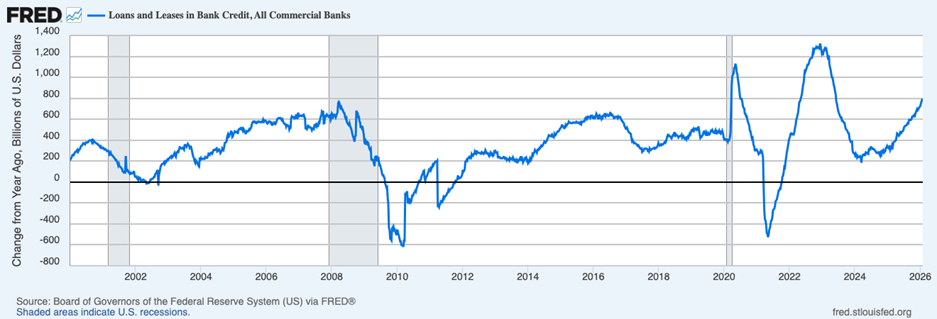
What’s interesting is that the opposite has not necessarily been true over the past few years. Even when the yield curve was inverted for the past two-plus years, bank lending didn’t stall. Total loan growth began in 2025 running at roughly a 2.7% year-over-year pace. By late November, it had accelerated to about 5.4% year over year. That is a meaningful improvement, especially considering rates were largely unchanged for much of the year and liquidity conditions were, by conventional standards, tightening rather than easing. As seen on the chart below, showing the year-over-year change in loans and leases in bank credit (in billions of U.S. dollars), credit has been flowing solidly since 2022.

Bank Lending (Year-over-Year Change in Billions of U.S. Dollars)

Source: Federal Reserve Bank of St. Louis 3

If lending strengthened in 2025 despite relatively tight policy conditions and a flat yield curve, it suggests the economy was already standing on a fairly solid footing. The read here for investors is that looking ahead, a steepening curve is a positive signal, but not because it suddenly “unlocks” growth. Rather, I see the steepening yield curve as reinforcing a trend that was already in place, which reflects normalization. And that’s a good thing, in my view.

Bottom Line for Investors

The yield curve steepening is a constructive development, and it fits with a broader picture of an economy that has generally been healthier than appreciated. Equally important, the past two years showed that growth and lending will not always grind to a halt simply because the curve is inverted, reminding us that many other forces are at work.

But there’s another takeaway here for investors: just as the inverted yield curve for much of 2023 did not signal an imminent recession, a steepening yield curve in 2026 should not necessarily be viewed as a critical turning point for big growth ahead. We’re expecting growth to be solid this year, to be sure. But we expected that outcome even with a flat yield curve, underscoring the fact that lending, spending, and growth have been strong even without a traditionally steep yield curve. In that sense, the recent steepening looks less like a prerequisite for growth and more like an added tailwind to an economy that was already in good shape.

Wall Street Journal. January 31, 2026. https://advisor.zacksim.com/e/376582/i1WiljnrifkKiDv64j154vmpAA3D3D/5v4q6k/1462235389/h/L8P_TOFJ4WYshjSJYlqvePaYN-TpiLeuioNeejw7qRw

Fred Economic Data. February 10, 2026. https://advisor.zacksim.com/e/376582/series-T10Y3M/5v4q6n/1462235389/h/L8P_TOFJ4WYshjSJYlqvePaYN-TpiLeuioNeejw7qRw

Fred Economic Data. February 6, 2026. https://advisor.zacksim.com/e/376582/series-TOTLL/5v4q6r/1462235389/h/L8P_TOFJ4WYshjSJYlqvePaYN-TpiLeuioNeejw7qRw

DISCLOSURE
Past performance is no guarantee of future results. Inherent in any investment is the potential for loss.

Zacks Investment Management, Inc. is a wholly-owned subsidiary of Zacks Investment Research. Zacks Investment Management is an independent Registered Investment Advisory firm and acts as an investment manager for individuals and institutions. Zacks Investment Research is a provider of earnings data and other financial data to institutions and to individuals.

This material is being provided for informational purposes only and nothing herein constitutes investment, legal, accounting or tax advice, or a recommendation to buy, sell or hold a security. Do not act or rely upon the information and advice given in this publication without seeking the services of competent and professional legal, tax, or accounting counsel. Publication and distribution of this article is not intended to create, and the information contained herein does not constitute, an attorney-client relationship. No recommendation or advice is being given as to whether any investment or strategy is suitable for a particular investor. It should not be assumed that any investments in securities, companies, sectors or markets identified and described were or will be profitable. All information is current as of the date of herein and is subject to change without notice. Any views or opinions expressed may not reflect those of the firm as a whole.

Any projections, targets, or estimates in this report are forward looking statements and are based on the firm’s research, analysis, and assumptions. Due to rapidly changing market conditions and the complexity of investment decisions, supplemental information and other sources may be required to make informed investment decisions based on your individual investment objectives and suitability specifications. All expressions of opinions are subject to change without notice. Clients should seek financial advice regarding the appropriateness of investing in any security or investment strategy discussed in this presentation.

Certain economic and market information contained herein has been obtained from published sources prepared by other parties.  Zacks Investment Management does not assume any responsibility for the accuracy or completeness of such information. Further, no third party has assumed responsibility for independently verifying the information contained herein and accordingly no such persons make any representations with respect to the accuracy, completeness or reasonableness of the information provided herein. Unless otherwise indicated, market analysis and conclusions are based upon opinions or assumptions that Zacks Investment Management considers to be reasonable. Any investment inherently involves a high degree of risk, beyond any specific risks discussed herein.

The S&P 500 Index is a well-known, unmanaged index of the prices of 500 large-company common stocks, mainly blue-chip stocks, selected by Standard & Poor’s. The S&P 500 Index assumes reinvestment of dividends but does not reflect advisory fees. The volatility of the benchmark may be materially different from the individual performance obtained by a specific investor. An investor cannot invest directly in an index.

The Russell 1000 Growth Index is a well-known, unmanaged index of the prices of 1000 large-company growth common stocks selected by Russell. The Russell 1000 Growth Index assumes reinvestment of dividends but does not reflect advisory fees. An investor cannot invest directly in an index. The volatility of the benchmark may be materially different from the individual performance obtained by a specific investor.

Nasdaq Composite Index is the market capitalization-weighted index of over 3,300 common equities listed on the Nasdaq stock exchange. The types of securities in the index include American depositary receipts, common stocks, real estate investment trusts (REITs) and tracking stocks, as well as limited partnership interests. The index includes all Nasdaq-listed stocks that are not derivatives, preferred shares, funds, exchange-traded funds (ETFs) or debenture securities. An investor cannot invest directly in an index. The volatility of the benchmark may be materially different from the individual performance obtained by a specific investor.

The Dow Jones Industrial Average measures the daily stock market movements of 30 U.S. publicly-traded companies listed on the NASDAQ or the New York Stock Exchange (NYSE). The 30 publicly-owned companies are considered leaders in the United States economy. An investor cannot directly invest in an index.  The volatility of the benchmark may be materially different from the individual performance obtained by a specific investor.

The Bloomberg Global Aggregate Index is a flagship measure of global investment grade debt from twenty-four local currency markets. This multi-currency benchmark includes treasury, government-related, corporate and securitized fixed-rate bonds from both developed and emerging markets issuers. An investor cannot invest directly in an index. The volatility of the benchmark may be materially different from the individual performance obtained by a specific investor.

The ICE Exchange-Listed Fixed & Adjustable Rate Preferred Securities Index is a modified market capitalization weighted index composed of preferred stock and securities that are functionally equivalent to preferred stock including, but not limited to, depositary preferred securities, perpetual subordinated debt and certain securities issued by banks and other financial institutions that are eligible for capital treatment with respect to such instruments akin to that received for issuance of straight preferred stock. An investor cannot invest directly in an index. The volatility of the benchmark may be materially different from the individual performance obtained by a specific investor.

The MSCI ACWI ex U.S. Index captures large and mid-cap representation across 22 of 23 Developed Markets (DM) countries (excluding the United States) and 24 Emerging Markets (EM) countries. The index covers approximately 85% of the global equity opportunity set outside the U.S. An investor cannot invest directly in an index. The volatility of the benchmark may be materially different from the individual performance obtained by a specific investor.

The Russell 2000 Index is a well-known, unmanaged index of the prices of 2000 small-cap company common stocks, selected by Russell. The Russell 2000 Index assumes reinvestment of dividends but does not reflect advisory fees. An investor cannot invest directly in an index. The volatility of the benchmark may be materially different from the individual performance obtained by a specific investor.

The S&P Mid Cap 400 provides investors with a benchmark for mid-sized companies. The index, which is distinct from the large-cap S&P 500, is designed to measure the performance of 400 mid-sized companies, reflecting the distinctive risk and return characteristics of this market segment.

The S&P 500 Pure Value index is a style-concentrated index designed to track the performance of stocks that exhibit the strongest value characteristics by using a style-attractiveness-weighting scheme. An investor cannot directly invest in an index.  The volatility of the benchmark may be materially different from the individual performance obtained by a specific investor.

Navigating Financial Conversations As A Couple

By Financial Planning

People get married at every age and stage of life but no matter the circumstances, you will still have to figure out how to make your finances work together. Open discussions can help lay a stronger foundation for your shared financial future. Here are some items to consider when planning with your partner to help you get started.

Figure Out Feelings

We know money is deeply emotional and is shaped by past experiences, learned behaviors, and future goals. These feelings form your personal “money philosophy,” and in a relationship, differences can lead to tension if not addressed.

Some people tend to be more frugal while others enjoy living in the moment, or one may embrace risk taking while the other prefers stability. While it’s true that individual decisions can impact joint financial goals, don’t jump into criticism. Start by listening without judgment so that you can truly understand one another.

For instance, share your personal money stories, like how some grew up in households where money wasn’t discussed, while others navigated around debt or financial stress. Ultimately, everyone’s money journey is unique and reflects security, freedom, or power. Be sure to communicate openly and listen carefully so that you can build a plan that works for both of you.

Total Transparency

Everyone brings a unique financial history of past mistakes, obligations, and experiences. Avoiding feelings of fear, shame, or discomfort won’t make problems go away. Being honest about your financial past and present helps both partners see the full picture, find common ground, and plan together. Full transparency means sharing what you bring to the relationship, including:

  • Assets – bank accounts, investments, real estate, retirement savings, or pensions
  • Income – from all jobs or other sources
  • Debt – credit cards, mortgages, car loans, student loans, or personal loans, including interest rates and your preferred repayment approach (aggressive or minimum payments)
  • Financial obligations – child support or alimony
  • Credit scores

Set Goals Together

You and your partner may not have identical financial goals and that’s okay. What matters is sharing your goals, values, and expectations to then find overlap. Establishing both short- and long-term goals together can help create a shared vision and make decision-making easier.

Short-term goals might include:

  • Paying off smaller debt balances
  • Building an emergency fund
  • Saving for a vacation or other near-term plans

Setting achievable short-term goals helps track progress, adjust spending habits, and celebrate wins along the way.

Long-term goals might include:

  • Buying a home
  • Starting a family
  • Saving for retirement

Discuss strategies that balance needs and wants and break down your priorities. And remember to remain flexible, because life is always changing.

Sharing a Budget, Finances, and Expenses

Managing money together most likely involves creating a shared budget and deciding how expenses will be handled. A strong system covers essentials like housing, transportation, and debt while still allowing room for individual spending. Reflect on how you’ve managed money separately and discuss what you’ll do differently as a couple.

Couples often choose from several budgeting and money-sharing approaches like fully merging finances, gradually combining accounts, keeping separate accounts with shared contributions, or assigning financial roles. Some even consider a prenuptial agreement to clarify asset ownership and debt responsibilities.

Using tools like spreadsheets, budgeting apps, or even just a pen and paper can help streamline responsibilities. You may also want to create a “money map,” which is a visual timeline of your financial plans and goals. It allows each partner to still dream without judgment, from vacations to long-term savings targets.

Planning Long-Term

Conversations about “what ifs” deserve their own dedicated time. The goal is long-term protection and security for both of you. Work through the following areas together and revisit them as your circumstances may change:

  • Beneficiary designations – review beneficiaries on all financial accounts, including 401(k) plans, IRAs, and any investment or bank accounts.
  • Estate planning documents – wills, powers of attorney, and health care directives.
  • Insurance coverage – life, disability, health, and dental insurance.
  • Taxes – talk about the implications of filing jointly versus individually.
  • Long-term care insurance – what if one of you develops a condition that makes you unable to perform the everyday tasks of living?
  • Retirement planning – will you retire? How and when? What is your dream?

Building a strong financial partnership takes honesty, communication, and ongoing planning. It’s crucial to understand each other’s perspectives so you can prepare for the future and create a plan that supports your life together.

And, you do not have to navigate these conversations alone. We are here to help guide you through the process, align your priorities, and develop a plan that keeps everyone on the same page. Contact us to start the conversation.


Sources:

https://www.principal.com/individuals/learn/6-money-conversations-have-marriage

https://www.fidelity.com/learning-center/personal-finance/communication-tips-couples

https://www.investopedia.com/6-important-money-conversations-to-have-with-your-partner-right-now-11798542

https://time.com/7268880/how-to-talk-about-money-with-partner/

https://www.kiplinger.com/kiplinger-advisor-collective/steps-for-better-money-conversations-with-your-spouse

https://www.cnbc.com/select/how-talk-your-partner-about-money/


Mitch Zacks – Weekly Market Commentary: “Precious Metals Rally Underscores the Hazards of Chasing Heat”

By Weekly Market Commentary

Gold and silver are all over the news. That alone should give investors pause.

In my read of the current market environment, the rally in precious metals is increasingly being supported by a growing list of rationales for why prices are sure to keep rising. Chief among them:

  • Trade tensions and tariff uncertainty have prompted central banks to ‘hedge’, increasing purchases of gold reserves.
  • Ongoing geopolitical risks, spanning the Middle East to Eastern Europe to Venezuela and Greenland, have reinforced the appeal of perceived “safe havens.”
  • Concerns that heavy government spending and monetary stimulus (via lack of Fed independence) could weaken the dollar and thus strengthen the appeal of gold.
  • And somewhat classically, as prices kept moving higher, fear of missing out has pulled in more retail dollars.

It’s worth stepping back and recognizing what these arguments above have in common. They are largely forward-looking concerns that often bake in worst-case outcomes and rest on several assumptions at once. The critical question for investors isn’t whether these risks exist, but what happens if reality turns out to be less dire than expected.

We saw a clear example of that just last week.

When news broke that Kevin Warsh would be nominated as the next Chair of the Federal Reserve, precious metals sharply sold off. Markets broadly view Warsh as a disciplined, independent central banker—someone who has argued for a smaller Federal Reserve balance sheet and a more restrained approach to monetary policy. That perception alone was enough to force a reassessment of the so-called “dollar debasement” trade that had been supporting gold and silver prices. No policy had changed, but an assumption had. Prices adjusted accordingly.

In my view, this example offered a timely reminder of how quickly sentiment-driven trades can reverse when expectations shift. The outcome was less-bad-than-feared, which unwound the rationale for ever-rising prices.

History offers plenty of similar lessons. During the Greek sovereign debt crisis in the early 2010s, investors worried that financial stress would spread throughout Europe and threaten the global system. Gold surged to record highs amid those fears, widely promoted as a necessary portfolio hedge. Yet as sentiment cooled and the debt crisis was contained, gold went on to fall more than 40% to a trough in 2015, four years later.​​​​​​

The 2008 Global Financial Crisis provides another example. In theory, 2008 should have been an ideal environment for gold. Instead, during the most acute phase of the crisis, gold declined alongside other risk assets as investors sought liquidity and reduced exposure broadly. The takeaway isn’t that gold is a bad investment; it’s that assets driven primarily by sentiment can behave in unexpected ways precisely when investors expect them to provide protection.

This pattern isn’t unique to commodities. Financial markets are full of episodes where investors chase recent winners based on narratives that feel compelling in the moment, only to discover later that price momentum and emotion—not durable fundamentals—were doing most of the work. When those emotions shift, reversals can take hold quickly.

Remember, long-term investment success does not rely on identifying the hottest trade of the moment. It is built on aligning portfolios with financial goals, time horizons, and risk tolerance, and building an allocation of assets with identifiable drivers of return. Stocks generate earnings and cash flow. Bonds provide income and contractual payments. Their returns can fluctuate, sometimes sharply, but they remain tethered to economic activity. Gold does not have these properties.

Bottom Line for Investors

It is easy to feel pressure to act when a particular asset is getting attention and prices are moving quickly. As gold’s recent run shows, those moves are often supported by a stack of assumptions that can change faster than investors expect.

The key takeaway here is not about the pros and cons of owning gold. It is about recognizing how sentiment-driven trades behave. When prices are rising on narratives rather than fundamentals, reversals can happen quickly once expectations shift. For long-term investors, the more reliable approach is to focus on asset allocations built around financial goals, time horizons, and risk tolerance, and rely on assets with identifiable drivers of return. It also means resisting the urge to chase what’s hot simply because it’s getting attention.

DISCLOSURE
Past performance is no guarantee of future results. Inherent in any investment is the potential for loss.

Zacks Investment Management, Inc. is a wholly-owned subsidiary of Zacks Investment Research. Zacks Investment Management is an independent Registered Investment Advisory firm and acts as an investment manager for individuals and institutions. Zacks Investment Research is a provider of earnings data and other financial data to institutions and to individuals.

This material is being provided for informational purposes only and nothing herein constitutes investment, legal, accounting or tax advice, or a recommendation to buy, sell or hold a security. Do not act or rely upon the information and advice given in this publication without seeking the services of competent and professional legal, tax, or accounting counsel. Publication and distribution of this article is not intended to create, and the information contained herein does not constitute, an attorney-client relationship. No recommendation or advice is being given as to whether any investment or strategy is suitable for a particular investor. It should not be assumed that any investments in securities, companies, sectors or markets identified and described were or will be profitable. All information is current as of the date of herein and is subject to change without notice. Any views or opinions expressed may not reflect those of the firm as a whole.

Any projections, targets, or estimates in this report are forward looking statements and are based on the firm’s research, analysis, and assumptions. Due to rapidly changing market conditions and the complexity of investment decisions, supplemental information and other sources may be required to make informed investment decisions based on your individual investment objectives and suitability specifications. All expressions of opinions are subject to change without notice. Clients should seek financial advice regarding the appropriateness of investing in any security or investment strategy discussed in this presentation.

Certain economic and market information contained herein has been obtained from published sources prepared by other parties.  Zacks Investment Management does not assume any responsibility for the accuracy or completeness of such information. Further, no third party has assumed responsibility for independently verifying the information contained herein and accordingly no such persons make any representations with respect to the accuracy, completeness or reasonableness of the information provided herein. Unless otherwise indicated, market analysis and conclusions are based upon opinions or assumptions that Zacks Investment Management considers to be reasonable. Any investment inherently involves a high degree of risk, beyond any specific risks discussed herein.

The S&P 500 Index is a well-known, unmanaged index of the prices of 500 large-company common stocks, mainly blue-chip stocks, selected by Standard & Poor’s. The S&P 500 Index assumes reinvestment of dividends but does not reflect advisory fees. The volatility of the benchmark may be materially different from the individual performance obtained by a specific investor. An investor cannot invest directly in an index.

The Russell 1000 Growth Index is a well-known, unmanaged index of the prices of 1000 large-company growth common stocks selected by Russell. The Russell 1000 Growth Index assumes reinvestment of dividends but does not reflect advisory fees. An investor cannot invest directly in an index. The volatility of the benchmark may be materially different from the individual performance obtained by a specific investor.

Nasdaq Composite Index is the market capitalization-weighted index of over 3,300 common equities listed on the Nasdaq stock exchange. The types of securities in the index include American depositary receipts, common stocks, real estate investment trusts (REITs) and tracking stocks, as well as limited partnership interests. The index includes all Nasdaq-listed stocks that are not derivatives, preferred shares, funds, exchange-traded funds (ETFs) or debenture securities. An investor cannot invest directly in an index. The volatility of the benchmark may be materially different from the individual performance obtained by a specific investor.

The Dow Jones Industrial Average measures the daily stock market movements of 30 U.S. publicly-traded companies listed on the NASDAQ or the New York Stock Exchange (NYSE). The 30 publicly-owned companies are considered leaders in the United States economy. An investor cannot directly invest in an index.  The volatility of the benchmark may be materially different from the individual performance obtained by a specific investor.

The Bloomberg Global Aggregate Index is a flagship measure of global investment grade debt from twenty-four local currency markets. This multi-currency benchmark includes treasury, government-related, corporate and securitized fixed-rate bonds from both developed and emerging markets issuers. An investor cannot invest directly in an index. The volatility of the benchmark may be materially different from the individual performance obtained by a specific investor.

The ICE Exchange-Listed Fixed & Adjustable Rate Preferred Securities Index is a modified market capitalization weighted index composed of preferred stock and securities that are functionally equivalent to preferred stock including, but not limited to, depositary preferred securities, perpetual subordinated debt and certain securities issued by banks and other financial institutions that are eligible for capital treatment with respect to such instruments akin to that received for issuance of straight preferred stock. An investor cannot invest directly in an index. The volatility of the benchmark may be materially different from the individual performance obtained by a specific investor.

The MSCI ACWI ex U.S. Index captures large and mid-cap representation across 22 of 23 Developed Markets (DM) countries (excluding the United States) and 24 Emerging Markets (EM) countries. The index covers approximately 85% of the global equity opportunity set outside the U.S. An investor cannot invest directly in an index. The volatility of the benchmark may be materially different from the individual performance obtained by a specific investor.

The Russell 2000 Index is a well-known, unmanaged index of the prices of 2000 small-cap company common stocks, selected by Russell. The Russell 2000 Index assumes reinvestment of dividends but does not reflect advisory fees. An investor cannot invest directly in an index. The volatility of the benchmark may be materially different from the individual performance obtained by a specific investor.

The S&P Mid Cap 400 provides investors with a benchmark for mid-sized companies. The index, which is distinct from the large-cap S&P 500, is designed to measure the performance of 400 mid-sized companies, reflecting the distinctive risk and return characteristics of this market segment.

The S&P 500 Pure Value index is a style-concentrated index designed to track the performance of stocks that exhibit the strongest value characteristics by using a style-attractiveness-weighting scheme. An investor cannot directly invest in an index.  The volatility of the benchmark may be materially different from the individual performance obtained by a specific investor.

Mitch Zacks – Weekly Market Commentary: “On My Radar: Rising Redemptions in Private Credit Funds”

By Weekly Market Commentary

Private credit funds have grown in popularity over the past few years. Marketed as a way to earn steady income, reduce volatility, and diversify beyond traditional stocks and bonds, these strategies found a receptive audience during a period of rising interest rates and strong demand for yield.

But last year offered a meaningful test of how these products behave when conditions shift.1

According to recent disclosures and reporting, several large private credit funds received redemption requests above their quarterly limits at the end of last year. In most cases, about 5% of fund assets were requested for withdrawal in a single quarter. This is a relatively high figure.

For investors who may not be familiar with these products, private credit funds, particularly business development companies (BDCs), typically lend to midsize companies with below-investment-grade credit ratings. The income they generate, and distribute to investors, comes largely from interest payments on those loans. When short-term interest rates rose sharply in 2022 and 2023, yields followed. Many private-credit strategies were distributing income north of 10%, making them especially attractive to income-focused investors.

But that relationship works both ways.

As interest rates stabilized and began to ease, loan yields tend to fall in lockstep. The result: several large private-credit funds have already reduced dividends, which has created a stir amongst investors (and also helps explain high distribution rates).

The numbers tell the story. Total returns from five of the largest private credit funds aimed at individual investors averaged about 11.4% in 2023, fell to roughly 8.8% in 2024, and declined further to around 6.2% in the first nine months of 2025. Those returns are still positive, but they are meaningfully lower than many investors had come to expect based on recent history.

But here’s the big issue. When investors see falling yields and attempt to shift their income strategy or move their money elsewhere, many realize for the first time that they cannot access all of their money. Many private credit funds are “semi-liquid,” meaning investors can request redemptions quarterly, but at a capped rate—often at 5% of fund assets per quarter, or 2% per month.

During periods of calm, redemption limits may not be much of an issue for long-term investors. But during periods of uncertainty and/or falling yields, they suddenly matter a great deal.

Limited liquidity and income variability can easily clash with the expectation of stability. For institutions with long-dated liabilities and stable capital, these limits are well understood and planned for. But limits don’t always align with the financial realities of individuals, who may need access to cash for healthcare expenses, tuition, or unexpected life events.

We saw a similar dynamic play out several years ago in private real estate, when redemption requests surged and funds were forced to restrict withdrawals. The lesson then, and now, is that liquidity constraints are not necessarily a flaw in these products. They are a feature. They allow managers to avoid forced asset sales and protect long-term investors. But they also require investors to plan carefully for near-term cash needs elsewhere.

None of this means private credit is “bad” or unsuitable in all cases. But it does mean the trade-offs are very important for investors to acknowledge and understand, and they become highly relevant precisely when conditions are less favorable.

Bottom Line for Investors

At this moment, the recent uptick in private credit redemptions does not constitute a crisis. But it does serve as an important reminder.

Private markets can play a role in diversified portfolios, but they demand a clear understanding of how returns are generated, how income can change, and when capital can realistically be accessed. Liquidity constraints become most important when markets turn choppy.

As efforts continue to broaden access to private investments, education matters more than ever. Investors should ask not only what a strategy offers when conditions are ideal, but how it behaves when expectations shift.

Wall Street Journal. January 21, 2026, https://advisor.zacksim.com/e/376582/-bc1e8cbc-mod-livecoverage-web/5v31n8/1448452501/h/yiEtBIn2YzHEb4yy6d38GViOVcfZY_n9dzfHx-EajoE

DISCLOSURE
Past performance is no guarantee of future results. Inherent in any investment is the potential for loss.

Zacks Investment Management, Inc. is a wholly-owned subsidiary of Zacks Investment Research. Zacks Investment Management is an independent Registered Investment Advisory firm and acts as an investment manager for individuals and institutions. Zacks Investment Research is a provider of earnings data and other financial data to institutions and to individuals.

This material is being provided for informational purposes only and nothing herein constitutes investment, legal, accounting or tax advice, or a recommendation to buy, sell or hold a security. Do not act or rely upon the information and advice given in this publication without seeking the services of competent and professional legal, tax, or accounting counsel. Publication and distribution of this article is not intended to create, and the information contained herein does not constitute, an attorney-client relationship. No recommendation or advice is being given as to whether any investment or strategy is suitable for a particular investor. It should not be assumed that any investments in securities, companies, sectors or markets identified and described were or will be profitable. All information is current as of the date of herein and is subject to change without notice. Any views or opinions expressed may not reflect those of the firm as a whole.

Any projections, targets, or estimates in this report are forward looking statements and are based on the firm’s research, analysis, and assumptions. Due to rapidly changing market conditions and the complexity of investment decisions, supplemental information and other sources may be required to make informed investment decisions based on your individual investment objectives and suitability specifications. All expressions of opinions are subject to change without notice. Clients should seek financial advice regarding the appropriateness of investing in any security or investment strategy discussed in this presentation.

Certain economic and market information contained herein has been obtained from published sources prepared by other parties.  Zacks Investment Management does not assume any responsibility for the accuracy or completeness of such information. Further, no third party has assumed responsibility for independently verifying the information contained herein and accordingly no such persons make any representations with respect to the accuracy, completeness or reasonableness of the information provided herein. Unless otherwise indicated, market analysis and conclusions are based upon opinions or assumptions that Zacks Investment Management considers to be reasonable. Any investment inherently involves a high degree of risk, beyond any specific risks discussed herein.

The S&P 500 Index is a well-known, unmanaged index of the prices of 500 large-company common stocks, mainly blue-chip stocks, selected by Standard & Poor’s. The S&P 500 Index assumes reinvestment of dividends but does not reflect advisory fees. The volatility of the benchmark may be materially different from the individual performance obtained by a specific investor. An investor cannot invest directly in an index.

The Russell 1000 Growth Index is a well-known, unmanaged index of the prices of 1000 large-company growth common stocks selected by Russell. The Russell 1000 Growth Index assumes reinvestment of dividends but does not reflect advisory fees. An investor cannot invest directly in an index. The volatility of the benchmark may be materially different from the individual performance obtained by a specific investor.

Nasdaq Composite Index is the market capitalization-weighted index of over 3,300 common equities listed on the Nasdaq stock exchange. The types of securities in the index include American depositary receipts, common stocks, real estate investment trusts (REITs) and tracking stocks, as well as limited partnership interests. The index includes all Nasdaq-listed stocks that are not derivatives, preferred shares, funds, exchange-traded funds (ETFs) or debenture securities. An investor cannot invest directly in an index. The volatility of the benchmark may be materially different from the individual performance obtained by a specific investor.

The Dow Jones Industrial Average measures the daily stock market movements of 30 U.S. publicly-traded companies listed on the NASDAQ or the New York Stock Exchange (NYSE). The 30 publicly-owned companies are considered leaders in the United States economy. An investor cannot directly invest in an index.  The volatility of the benchmark may be materially different from the individual performance obtained by a specific investor.

The Bloomberg Global Aggregate Index is a flagship measure of global investment grade debt from twenty-four local currency markets. This multi-currency benchmark includes treasury, government-related, corporate and securitized fixed-rate bonds from both developed and emerging markets issuers. An investor cannot invest directly in an index. The volatility of the benchmark may be materially different from the individual performance obtained by a specific investor.

The ICE Exchange-Listed Fixed & Adjustable Rate Preferred Securities Index is a modified market capitalization weighted index composed of preferred stock and securities that are functionally equivalent to preferred stock including, but not limited to, depositary preferred securities, perpetual subordinated debt and certain securities issued by banks and other financial institutions that are eligible for capital treatment with respect to such instruments akin to that received for issuance of straight preferred stock. An investor cannot invest directly in an index. The volatility of the benchmark may be materially different from the individual performance obtained by a specific investor.

The MSCI ACWI ex U.S. Index captures large and mid-cap representation across 22 of 23 Developed Markets (DM) countries (excluding the United States) and 24 Emerging Markets (EM) countries. The index covers approximately 85% of the global equity opportunity set outside the U.S. An investor cannot invest directly in an index. The volatility of the benchmark may be materially different from the individual performance obtained by a specific investor.

The Russell 2000 Index is a well-known, unmanaged index of the prices of 2000 small-cap company common stocks, selected by Russell. The Russell 2000 Index assumes reinvestment of dividends but does not reflect advisory fees. An investor cannot invest directly in an index. The volatility of the benchmark may be materially different from the individual performance obtained by a specific investor.

The S&P Mid Cap 400 provides investors with a benchmark for mid-sized companies. The index, which is distinct from the large-cap S&P 500, is designed to measure the performance of 400 mid-sized companies, reflecting the distinctive risk and return characteristics of this market segment.

The S&P 500 Pure Value index is a style-concentrated index designed to track the performance of stocks that exhibit the strongest value characteristics by using a style-attractiveness-weighting scheme. An investor cannot directly invest in an index.  The volatility of the benchmark may be materially different from the individual performance obtained by a specific investor.