Monthly Archives

April 2026

10 Things You Need to Know About Retirement

By Financial Planning, Retirement Planning

April is Financial Literacy Month, which means it’s a great time to revisit the basics and take a closer look at your long-term financial plan. The earlier you build a strong foundation, the better equipped you are to make informed decisions, protect what you earn, and grow your savings over time. Whether retirement is close by or still a long way off, here are 10 important things to know about retirement.

  1. Retirement is a process, not a single date

A happy and fulfilling retirement means different things to different people. Likewise, the journey there is just as unique. Many people transition gradually, working part-time or adjusting their timeline, whether due to financial necessity or lifestyle choice. The Bureau of Labor Statistics notes that more Americans are including work as part of their retirement plans. If you claim Social Security before full retirement age, benefits may be reduced if your earnings are above certain limits. Understanding how claiming age, income, and Social Security rules interact can help you plan smarter and avoid surprises.

  1. How much you’ll need to for retirement

The amount you need depends on your lifestyle, health, expected retirement age, and income sources. Focus on what you actually expect to spend, not just your current income. Some costs, like commuting, may drop, while others, like healthcare, may rise. Consider how long your retirement may last, the effects of inflation over time, and any other income sources such as Social Security, pensions, or investments, which can help reduce how much you need to save but should be evaluated within your overall plan. A financial professional can help you make these calculations and adjustments.

  1. Your retirement could be very long

Many dream of a long retirement, but few realize just how long it could last. Since 1980, the number of Americans aged 90 and older has nearly tripled. Women tend to outlive men, and a 65-year-old today can expect almost two more decades of life on average. If you retire at 62 and live to 95, your retirement could last 33 years, far longer than many people’s working careers. That makes it clear you cannot fund three decades of retirement with only 15 years of savings.

  1. Retirement is a bit different for women than for men

Retirement can be more challenging for women for several reasons. Women generally live longer than men, which can mean higher healthcare and long-term care costs. Additionally, women are more likely to take career breaks (caregiving for children or elderly relatives) and earn less over their lifetimes, leading to smaller Social Security benefits and retirement savings. As a result, women often face larger income drops and greater retirement security gaps than men.

  1. Healthcare costs can add up

Planning for medical expenses, including Medicare coverage, is essential. According to Fidelity’s 2025 Retirement Health Care Cost Estimate, a 65-year-old couple retiring today may need about $315,000 to cover healthcare costs in retirement, not including long-term care. A single retiree might need roughly $150,000. Being covered by Medicare can make a big difference, so it’s important to understand your options and make informed decisions to avoid costly mistakes.

Staying healthy may not be at the top of your retirement to-do list, but it should be. Better health can reduce healthcare costs and help your savings last longer. This means preparing healthier meals, staying active, and routinely seeing your healthcare providers for checkups.

  1. Taxes don’t go away in retirement

Many retirees assume their income will be tax-free, but that’s not the case. Withdrawals from traditional accounts like 401(k)s and IRAs, as well as portions of Social Security, may be taxed, while Roth accounts can offer tax-free withdrawals if certain conditions are met. Additionally, you’ll still face sales taxes on things you buy and property taxes on property you own. If you don’t plan for taxes, you could end up withdrawing more than expected, which can reduce how long your nest egg lasts.

  1. Senior discounts are one of the major retirement perks

Senior discounts are widely available across retail, groceries, entertainment, dining, travel, and healthcare. While Medicare eligibility begins at 65, many discounts start as early as age 55, with others beginning at 60. Some offers may require an AARP membership or proof of eligibility, such as SSI. Remember that there is no legal requirement to offer discounts to seniors, so it pays to ask before purchasing.

  1. You still need an emergency fund

Few of us head into retirement expecting the worst, but sometimes it happens. Financial emergencies happen in all phases of our lives, and it’s vital to be able to take care of them without raiding retirement coffers or other important accounts. Your car might suddenly need a $2,000 repair, for example, or your roof might develop a leak.

  1. Understand your retirement accounts and RMDs

Different retirement accounts are taxed in different ways, and understanding these rules can have a significant impact on your savings. Your choice between traditional and Roth accounts should consider your current tax bracket, expected future income, and overall financial goals. Additionally, health savings accounts (HSAs) can offer unique tax benefits when used for qualified medical expenses in retirement.

At age 73, you’re required to take annual RMDs from all traditional (non-Roth) retirement accounts, including IRAs, 401(k)s, and similar plans. RMDs aren’t automatic, so you must proactively take them, generally by December 31, except for your first RMD, which can be delayed until April 1 of the year after you turn 73. Missing the deadline can result in income taxes plus a 25% penalty.

  1. Your retirement plan should evolve over time

Retirement planning isn’t static. Life circumstances, tax laws, market conditions, and personal goals change over time, so your plan needs to adapt accordingly. Working with a professional provides informed guidance to help you adjust strategies, optimize investments, manage risks, and seize opportunities you might otherwise miss.


Contact us today to get the guidance you need for a secure retirement. Contact BayTrust Financial today to take the first step toward building a lasting legacy.


Sources:

https://insights.smartasset.com/7-of-the-biggest-rmd-mistakes-people-make

https://home.treasury.gov/news/featured-stories/spotlighting-womens-retirement-security

https://www.retirementliving.com/aging-in-place/life-expectancy-statistics

https://legalclarity.org/how-many-years-does-the-average-person-collect-social-security/

https://www.aarp.org/money/retirement/steps-to-take-before-you-retire/?msockid=38e0a92211f36c2300d0bfa510206d73

https://www.investopedia.com/terms/r/retirement-planning.asp

https://newsroom.fidelity.com/pressreleases/fidelity-investments–releases-2025-retiree-health-care-cost-estimate–a-timely-reminder-for-all-gen/s/3c62e988-12e2-4dc8-afb4-f44b06c6d52e

https://www.seniorliving.org/finance/senior-discounts/

https://www.thoughtco.com/living-past-90-in-america-3321510

https://www.fidelity.com/learning-center/wealth-management-insights/cut-retirement-income-taxes

Mitch Zacks – Weekly Market Commentary: Is Rising Inflation Diminishing Hope for Another Rate Cut?

By Weekly Market Commentary

At the start of the year, developed-market central banks like the Fed, the European Central Bank, and the Bank of England were almost uniformly poised to gradually ease rates.

A lot can change in a quarter.

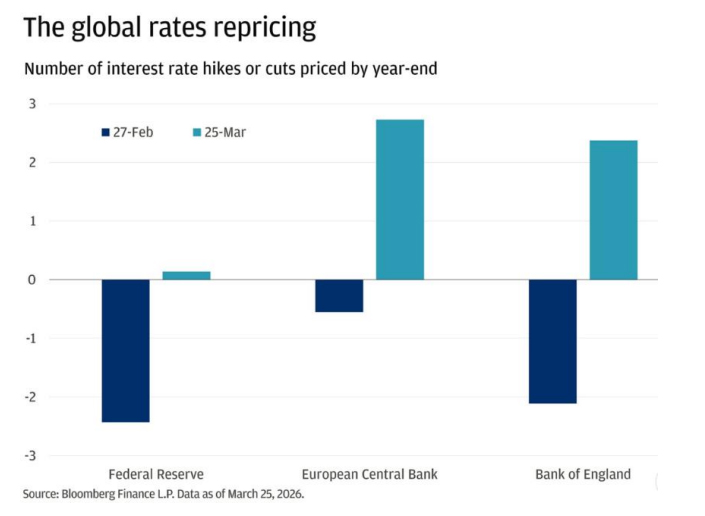
As seen in the chart below, markets have rapidly repriced the monetary policy outlook in response to the conflict in Iran. What started as an expectation for steady rate cuts in 2026 has shifted the expectation for rate hikes.1

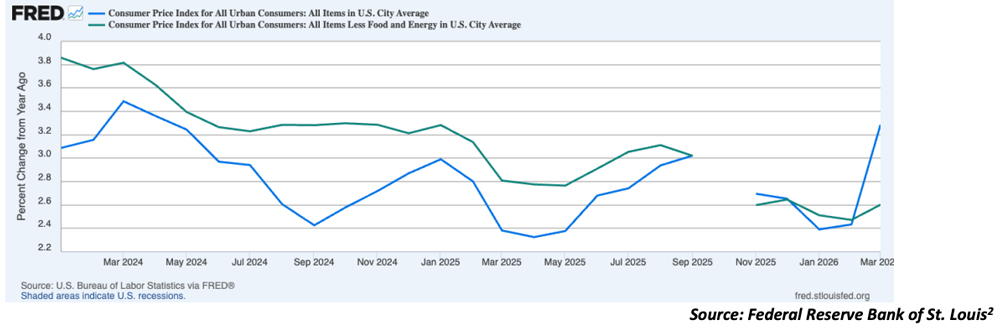
The catalyst behind this repricing is clear. The closure of the Strait of Hormuz has pushed oil and natural gas prices higher, feeding directly into global inflation data. Here in the U.S., March’s Consumer Price Index (CPI) report showed headline inflation rising 3.3% year-over-year, a sharp increase from February’s 2.4% pace, with energy prices up 12.5% and gasoline alone jumping nearly 19%. As seen on the chart below, there’s a sharp divergence in inflation data when it includes energy prices (headline), versus when it’s stripped out (core).

Consumer Price Index, January 2024 – March 2026 (blue line is headline, green line is core)

The gap in the chart seen above is important. While headline inflation jumped, core CPI rose a lesser 2.6% year-over-year, which was slightly below expectations. Food prices were largely flat, and many goods categories showed limited pass-through from higher energy costs. In other words, it’s clear that inflation pressure is not broad-based at this stage.

This is an important distinction when considering monetary policy in the U.S. versus abroad. In Europe and the U.K., central banks operate under more explicitly inflation-focused mandates and economies are more exposed to energy costs. The U.S. jobs market is equally important to the Fed, and our economy is far less exposed, given we’re a net exporter of oil and gas. That’s why I think the market pricing-in Fed hikes in 2026 is premature and likely off-base.

To be sure, a prolonged period of elevated energy prices could justify keeping rates higher for longer, delaying the timing of rate cuts. But despite a meaningful shift in underlying inflation dynamics or expectations, the bar for renewed rate hikes remains high, in my view. In that sense, markets may be interpreting a change in timing as a change in direction. That would make a potential rate cut in 2026 a positive surprise, which I see as a net positive for stocks.

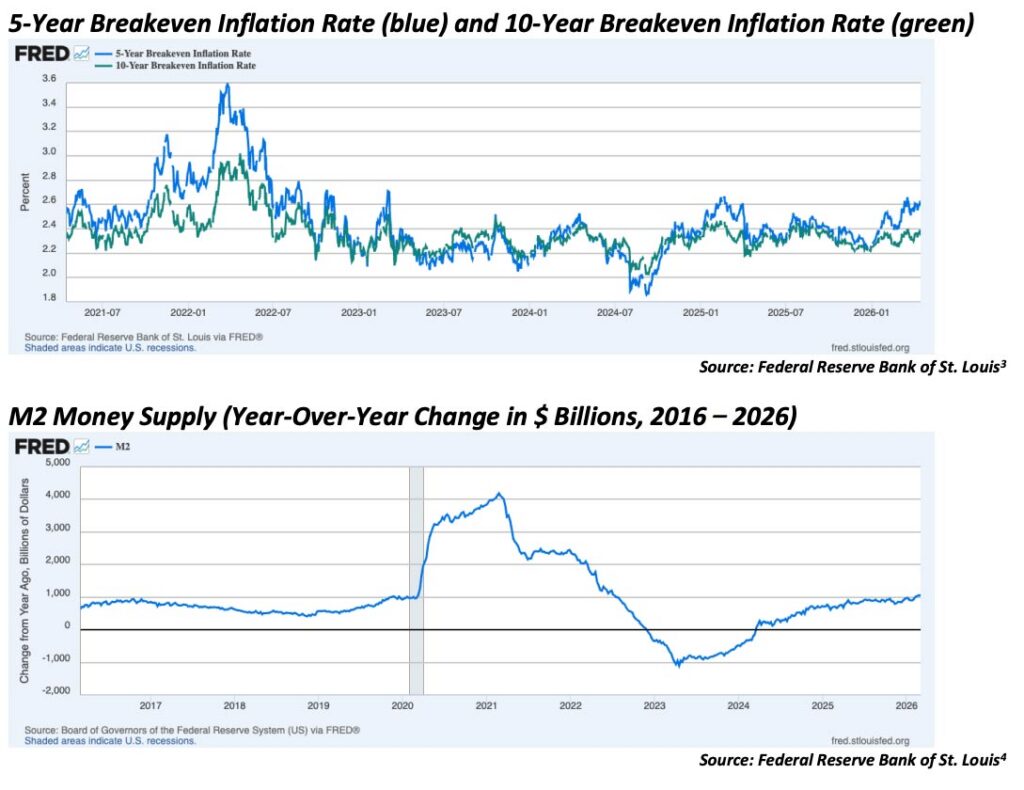
My conviction on this point comes from looking at market-based measures such as 5- and 10-year breakeven rates, which continue to hover in the low-to-mid 2% range. And I’d also cite money supply growth, which has returned to a much more modest pace and is broadly in line with pre-pandemic trends.

5-Year Breakeven Inflation Rate (blue) and 10-Year Breakeven Inflation Rate (green)

Investors should keep in mind that not every inflation spike carries the same policy implications. A rise in headline CPI driven by energy is very different from a broad, demand-led acceleration in prices, and central banks, and especially the Federal Reserve, know that. That is why I think the Fed is more likely to treat the latest inflation data as a reason for caution, not a reason to reverse course. Other developed-market central banks may have less room to look through the shock, but in the U.S., the more likely policy shift is a delay to easing, not the start of a new hiking cycle.

Bottom Line for Investors

Even if markets continue to debate the path of monetary policy, the bigger story for investors may be that the economy appears less dependent on near-term Fed decisions than many assume. S&P 500 earnings are expected to grow to +13.1% in Q1 on +9% higher revenues, with early reports showing +76.6% earnings growth and strong beat rates. Remember that this strength has emerged even as the Fed has taken a relatively limited role in actively supporting growth.

Looking ahead, policy expectations may continue to shift, but underlying drivers of markets like earnings, demand, and corporate fundamentals continue to look strong, regardless of what action central banks take in the near term.

J.P. Morgan. March 27, 2026. https://advisor.zacksim.com/e/376582/ll-central-banks-actually-hike/5vc4px/1515207807/h/WRUY0VCH93f7whKO2tPhc2Ju75rCuDaTuRb41p8x9wI

Fred Economic Data. April 10, 2026. https://advisor.zacksim.com/e/376582/series-CPIAUCSL/5vc4q1/1515207807/h/WRUY0VCH93f7whKO2tPhc2Ju75rCuDaTuRb41p8x9wI

Fred Economic Data. April 10, 2026. https://advisor.zacksim.com/e/376582/series-EXPINF5YR/5vc4q4/1515207807/h/WRUY0VCH93f7whKO2tPhc2Ju75rCuDaTuRb41p8x9wI

Fred Economic Data. March 24, 2026. https://advisor.zacksim.com/e/376582/series-WM2NS/5vc4q7/1515207807/h/WRUY0VCH93f7whKO2tPhc2Ju75rCuDaTuRb41p8x9wI

DISCLOSURE
Past performance is no guarantee of future results. Inherent in any investment is the potential for loss.

Zacks Investment Management, Inc. is a wholly-owned subsidiary of Zacks Investment Research. Zacks Investment Management is an independent Registered Investment Advisory firm and acts as an investment manager for individuals and institutions. Zacks Investment Research is a provider of earnings data and other financial data to institutions and to individuals.

This material is being provided for informational purposes only and nothing herein constitutes investment, legal, accounting or tax advice, or a recommendation to buy, sell or hold a security. Do not act or rely upon the information and advice given in this publication without seeking the services of competent and professional legal, tax, or accounting counsel. Publication and distribution of this article is not intended to create, and the information contained herein does not constitute, an attorney-client relationship. No recommendation or advice is being given as to whether any investment or strategy is suitable for a particular investor. It should not be assumed that any investments in securities, companies, sectors or markets identified and described were or will be profitable. All information is current as of the date of herein and is subject to change without notice. Any views or opinions expressed may not reflect those of the firm as a whole.

Any projections, targets, or estimates in this report are forward looking statements and are based on the firm’s research, analysis, and assumptions. Due to rapidly changing market conditions and the complexity of investment decisions, supplemental information and other sources may be required to make informed investment decisions based on your individual investment objectives and suitability specifications. All expressions of opinions are subject to change without notice. Clients should seek financial advice regarding the appropriateness of investing in any security or investment strategy discussed in this presentation.

Certain economic and market information contained herein has been obtained from published sources prepared by other parties.  Zacks Investment Management does not assume any responsibility for the accuracy or completeness of such information. Further, no third party has assumed responsibility for independently verifying the information contained herein and accordingly no such persons make any representations with respect to the accuracy, completeness or reasonableness of the information provided herein. Unless otherwise indicated, market analysis and conclusions are based upon opinions or assumptions that Zacks Investment Management considers to be reasonable. Any investment inherently involves a high degree of risk, beyond any specific risks discussed herein.

The S&P 500 Index is a well-known, unmanaged index of the prices of 500 large-company common stocks, mainly blue-chip stocks, selected by Standard & Poor’s. The S&P 500 Index assumes reinvestment of dividends but does not reflect advisory fees. The volatility of the benchmark may be materially different from the individual performance obtained by a specific investor. An investor cannot invest directly in an index. 

The Russell 1000 Growth Index is a well-known, unmanaged index of the prices of 1000 large-company growth common stocks selected by Russell. The Russell 1000 Growth Index assumes reinvestment of dividends but does not reflect advisory fees. An investor cannot invest directly in an index. The volatility of the benchmark may be materially different from the individual performance obtained by a specific investor.

Nasdaq Composite Index is the market capitalization-weighted index of over 3,300 common equities listed on the Nasdaq stock exchange. The types of securities in the index include American depositary receipts, common stocks, real estate investment trusts (REITs) and tracking stocks, as well as limited partnership interests. The index includes all Nasdaq-listed stocks that are not derivatives, preferred shares, funds, exchange-traded funds (ETFs) or debenture securities. An investor cannot invest directly in an index. The volatility of the benchmark may be materially different from the individual performance obtained by a specific investor.

The Dow Jones Industrial Average measures the daily stock market movements of 30 U.S. publicly-traded companies listed on the NASDAQ or the New York Stock Exchange (NYSE). The 30 publicly-owned companies are considered leaders in the United States economy. An investor cannot directly invest in an index.  The volatility of the benchmark may be materially different from the individual performance obtained by a specific investor.

The Bloomberg Global Aggregate Index is a flagship measure of global investment grade debt from twenty-four local currency markets. This multi-currency benchmark includes treasury, government-related, corporate and securitized fixed-rate bonds from both developed and emerging markets issuers. An investor cannot invest directly in an index. The volatility of the benchmark may be materially different from the individual performance obtained by a specific investor.

The ICE Exchange-Listed Fixed & Adjustable Rate Preferred Securities Index is a modified market capitalization weighted index composed of preferred stock and securities that are functionally equivalent to preferred stock including, but not limited to, depositary preferred securities, perpetual subordinated debt and certain securities issued by banks and other financial institutions that are eligible for capital treatment with respect to such instruments akin to that received for issuance of straight preferred stock. An investor cannot invest directly in an index. The volatility of the benchmark may be materially different from the individual performance obtained by a specific investor.

The MSCI ACWI ex U.S. Index captures large and mid-cap representation across 22 of 23 Developed Markets (DM) countries (excluding the United States) and 24 Emerging Markets (EM) countries. The index covers approximately 85% of the global equity opportunity set outside the U.S. An investor cannot invest directly in an index. The volatility of the benchmark may be materially different from the individual performance obtained by a specific investor.

The Russell 2000 Index is a well-known, unmanaged index of the prices of 2000 small-cap company common stocks, selected by Russell. The Russell 2000 Index assumes reinvestment of dividends but does not reflect advisory fees. An investor cannot invest directly in an index. The volatility of the benchmark may be materially different from the individual performance obtained by a specific investor.

The S&P Mid Cap 400 provides investors with a benchmark for mid-sized companies. The index, which is distinct from the large-cap S&P 500, is designed to measure the performance of 400 mid-sized companies, reflecting the distinctive risk and return characteristics of this market segment.

The S&P 500 Pure Value index is a style-concentrated index designed to track the performance of stocks that exhibit the strongest value characteristics by using a style-attractiveness-weighting scheme. An investor cannot directly invest in an index.  The volatility of the benchmark may be materially different from the individual performance obtained by a specific investor.

Mitch Zacks – Weekly Market Commentary: What Headline-Driven Investing Is Really Costing You

By Weekly Market Commentary

The U.S. made an announcement on the global stage that sent the media into a tizzy and financial markets into heightened downside volatility. Investors were left guessing what might come next, and how long the uncertainty would last. Was this the beginning of drawn-out tensions on the global stage? Would a recession and/or bear market follow?

I’m not describing the recent escalation in the Middle East. I’m thinking back to almost exactly one year ago, when sweeping tariff announcements triggered a sharp market selloff and a wave of pessimism about global growth. Investors likely remember how sharply the equity markets initially reacted. Global equities fell roughly -11% in a matter of days.

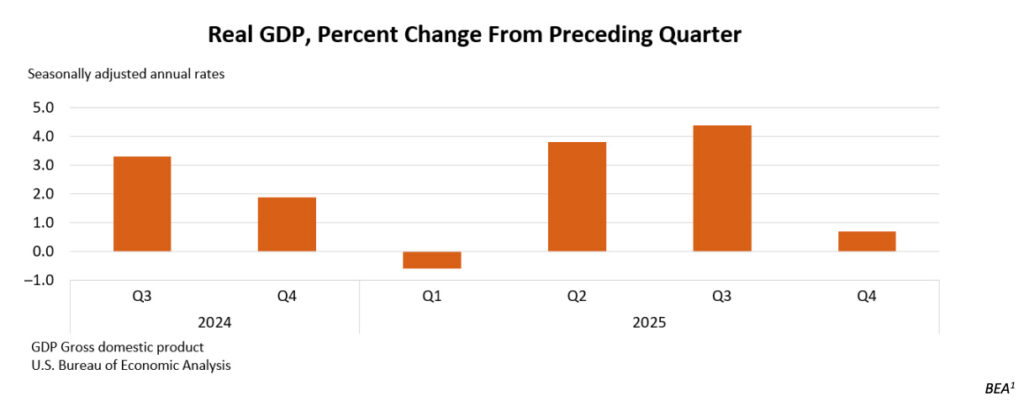
But the reaction didn’t last long, and we didn’t see a bear market or a recession last year. One could argue that 2025 delivered the opposite. The S&P 500 rose nearly +18% in 2025, while the U.S. economy accelerated into the third quarter, finishing the year with modest but positive GDP growth.

What is critical for investors to remember, in my view, is that tariff headlines and trade tensions did not necessarily let up as the year went on. It would be hard to argue that we ever got ‘certainty’ on trade policy in 2025. We didn’t. But markets did not wait for trade deals to be finalized, for tariffs to be rolled back, or for uncertainty to disappear. Stocks adjusted expectations quickly and moved on.

Last year’s tariff case study underscores what I mean by ‘the cost of headline-driven decision making.’ With the current war in Iran, timing the announcement of a two-week cease-fire may have looked like a great trade on paper, but I think the smarter money would have avoided the short-term volatility altogether. As last year’s tariff episode reminds us, markets can remain very choppy in an hour-to-hour news cycle, and it’s easy for investors to get baited into changing course quickly—which can mean failing to fully participate in the longer-term recovery.

In my view, the same dynamic is at play today. Markets are once again being driven by a steady stream of headlines, only this time it’s centered on geopolitical risk, energy supply, and the Strait of Hormuz. Investors are left trying to assess not just what is happening, but how long it will last and what it means for markets.

Equities are responding in real time, but the price action is not as severe as it was last year. It’s also true that the U.S. has fared far better than international markets over the past several weeks. The U.S. is far less exposed to rising energy costs than many of its global peers, given its role as a major oil and natural gas producer. By contrast, regions like Europe remain heavily reliant on imported energy. Estimates suggest that oil and LNG imports account for roughly 1% to 2% of eurozone GDP, compared to a modest positive contribution from net energy exports in the U.S.2

This isn’t a call to favor U.S. over foreign stocks on this headline alone. It is simply a reminder that the economic consequences of a prolonged conflict are unlikely to fall evenly across regions, and that higher energy prices do not automatically translate into broad-based weakness in the U.S. economy.

If last year’s tariff episode taught investors anything, it is that markets do not wait for resolution. They adjust to the range of possible outcomes quickly, and they often move on well before the news flow improves or the uncertainty fully clears. The same may be true here. By the time this conflict feels more settled and the outlook appears clearer, markets may have already done much of their repricing. The two-week cease-fire may hold, and it may not. Investors would be better served looking further out on the horizon, in my view.

Bottom Line for Investors

The real risk in environments like this isn’t the market volatility itself. It’s how investors respond. Periods driven by macro headlines can create the illusion that action is required, whether that means buying into weakness or pulling back until uncertainty fades. But last year’s tariff episode showed how unreliable that instinct can be. The most significant market moves often occur before the news flow improves, not after.

That’s why trying to position around how geopolitical events unfold is rarely productive. It requires getting both the outcome and the timing right, which is simply not possible without a great deal 

BEA. 2026. https://www.bea.gov/system/files/gdp4q25-2nd-chart-01.png

Wall Street Journal. April 4, 2026. https://advisor.zacksim.com/e/376582/-mod-economy-feat1-global-pos2/5vbfv7/1508659551/h/9XYSbfdZsg3fDfMt7mtAz1z8jVNLpHqtRgZFJVGJpkg

DISCLOSURE
Past performance is no guarantee of future results. Inherent in any investment is the potential for loss.

Zacks Investment Management, Inc. is a wholly-owned subsidiary of Zacks Investment Research. Zacks Investment Management is an independent Registered Investment Advisory firm and acts as an investment manager for individuals and institutions. Zacks Investment Research is a provider of earnings data and other financial data to institutions and to individuals.

This material is being provided for informational purposes only and nothing herein constitutes investment, legal, accounting or tax advice, or a recommendation to buy, sell or hold a security. Do not act or rely upon the information and advice given in this publication without seeking the services of competent and professional legal, tax, or accounting counsel. Publication and distribution of this article is not intended to create, and the information contained herein does not constitute, an attorney-client relationship. No recommendation or advice is being given as to whether any investment or strategy is suitable for a particular investor. It should not be assumed that any investments in securities, companies, sectors or markets identified and described were or will be profitable. All information is current as of the date of herein and is subject to change without notice. Any views or opinions expressed may not reflect those of the firm as a whole.

Any projections, targets, or estimates in this report are forward looking statements and are based on the firm’s research, analysis, and assumptions. Due to rapidly changing market conditions and the complexity of investment decisions, supplemental information and other sources may be required to make informed investment decisions based on your individual investment objectives and suitability specifications. All expressions of opinions are subject to change without notice. Clients should seek financial advice regarding the appropriateness of investing in any security or investment strategy discussed in this presentation.

Certain economic and market information contained herein has been obtained from published sources prepared by other parties.  Zacks Investment Management does not assume any responsibility for the accuracy or completeness of such information. Further, no third party has assumed responsibility for independently verifying the information contained herein and accordingly no such persons make any representations with respect to the accuracy, completeness or reasonableness of the information provided herein. Unless otherwise indicated, market analysis and conclusions are based upon opinions or assumptions that Zacks Investment Management considers to be reasonable. Any investment inherently involves a high degree of risk, beyond any specific risks discussed herein.

The S&P 500 Index is a well-known, unmanaged index of the prices of 500 large-company common stocks, mainly blue-chip stocks, selected by Standard & Poor’s. The S&P 500 Index assumes reinvestment of dividends but does not reflect advisory fees. The volatility of the benchmark may be materially different from the individual performance obtained by a specific investor. An investor cannot invest directly in an index. 

The Russell 1000 Growth Index is a well-known, unmanaged index of the prices of 1000 large-company growth common stocks selected by Russell. The Russell 1000 Growth Index assumes reinvestment of dividends but does not reflect advisory fees. An investor cannot invest directly in an index. The volatility of the benchmark may be materially different from the individual performance obtained by a specific investor.

Nasdaq Composite Index is the market capitalization-weighted index of over 3,300 common equities listed on the Nasdaq stock exchange. The types of securities in the index include American depositary receipts, common stocks, real estate investment trusts (REITs) and tracking stocks, as well as limited partnership interests. The index includes all Nasdaq-listed stocks that are not derivatives, preferred shares, funds, exchange-traded funds (ETFs) or debenture securities. An investor cannot invest directly in an index. The volatility of the benchmark may be materially different from the individual performance obtained by a specific investor.

The Dow Jones Industrial Average measures the daily stock market movements of 30 U.S. publicly-traded companies listed on the NASDAQ or the New York Stock Exchange (NYSE). The 30 publicly-owned companies are considered leaders in the United States economy. An investor cannot directly invest in an index.  The volatility of the benchmark may be materially different from the individual performance obtained by a specific investor.

The Bloomberg Global Aggregate Index is a flagship measure of global investment grade debt from twenty-four local currency markets. This multi-currency benchmark includes treasury, government-related, corporate and securitized fixed-rate bonds from both developed and emerging markets issuers. An investor cannot invest directly in an index. The volatility of the benchmark may be materially different from the individual performance obtained by a specific investor.

The ICE Exchange-Listed Fixed & Adjustable Rate Preferred Securities Index is a modified market capitalization weighted index composed of preferred stock and securities that are functionally equivalent to preferred stock including, but not limited to, depositary preferred securities, perpetual subordinated debt and certain securities issued by banks and other financial institutions that are eligible for capital treatment with respect to such instruments akin to that received for issuance of straight preferred stock. An investor cannot invest directly in an index. The volatility of the benchmark may be materially different from the individual performance obtained by a specific investor.

The MSCI ACWI ex U.S. Index captures large and mid-cap representation across 22 of 23 Developed Markets (DM) countries (excluding the United States) and 24 Emerging Markets (EM) countries. The index covers approximately 85% of the global equity opportunity set outside the U.S. An investor cannot invest directly in an index. The volatility of the benchmark may be materially different from the individual performance obtained by a specific investor.

The Russell 2000 Index is a well-known, unmanaged index of the prices of 2000 small-cap company common stocks, selected by Russell. The Russell 2000 Index assumes reinvestment of dividends but does not reflect advisory fees. An investor cannot invest directly in an index. The volatility of the benchmark may be materially different from the individual performance obtained by a specific investor.

The S&P Mid Cap 400 provides investors with a benchmark for mid-sized companies. The index, which is distinct from the large-cap S&P 500, is designed to measure the performance of 400 mid-sized companies, reflecting the distinctive risk and return characteristics of this market segment.

The S&P 500 Pure Value index is a style-concentrated index designed to track the performance of stocks that exhibit the strongest value characteristics by using a style-attractiveness-weighting scheme. An investor cannot directly invest in an index.  The volatility of the benchmark may be materially different from the individual performance obtained by a specific investor.

Mitch Zacks – Weekly Market Commentary: A Market Reset, Not a Breakdown

By Weekly Market Commentary

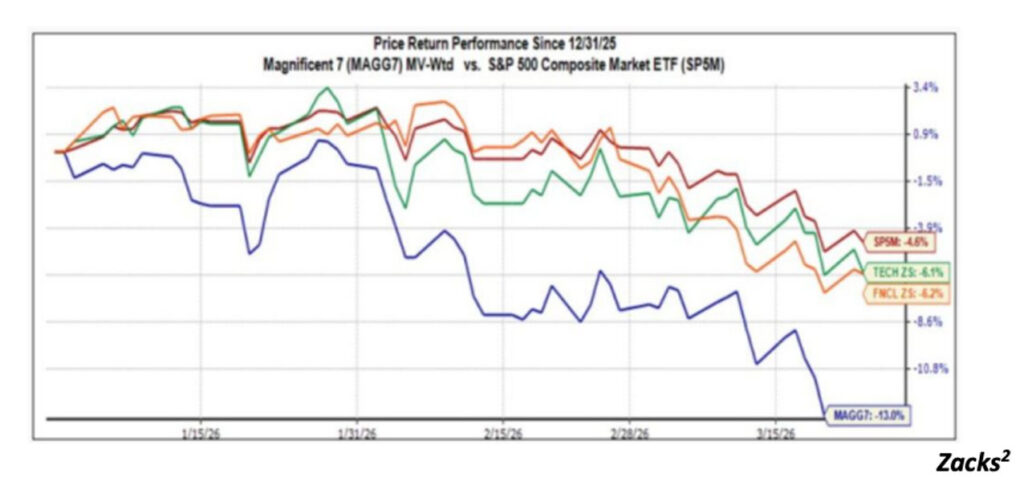
Market volatility continues apace, as news headlines, and even simple statements or policy hints, have shown the ability to move markets quickly in both directions. This kind of short-term volatility can feel like it carries greater meaning in the moment. But it doesn’t always tell us much about what is happening beneath the surface. In fact, it often gives investors the wrong message.1

My case-in-point this week: the growing gap between the market’s largest growth stocks and the broader index. As shown below, the once-heralded names in Technology and the “Magnificent Seven” have declined significantly more than the S&P 500 overall in 2026, with drawdowns approaching three times the magnitude of the broader market.

This divergence is notable not just because of the size of the move, but because of what is happening on the fundamental side at the same time.

‘Mag 7’ and Tech represent the largest growth-oriented segment of the market, and they continue to deliver the strongest earnings growth in the index. The Technology sector, broadly defined, is expected to produce earnings growth of more than 25% in the first quarter on over 20% revenue growth. By comparison, total S&P 500 earnings are expected to rise in the low double digits, and closer to mid-single digits if you exclude Technology’s contribution.

In other words, the sector doing the most to drive earnings growth is also the one experiencing the most pronounced selling pressure.

In fairness, some of this may reflect valuation concerns. Large-cap growth stocks entered the year trading at elevated multiples, and in periods of uncertainty, investors often trim exposure to the most expensive areas of the market first. There are also legitimate questions about how artificial intelligence may reshape competitive dynamics over time, particularly across software and digital platforms. But even taking those factors into account, the magnitude of the recent move appears disproportionate to what we are seeing in current earnings data. If anything, the disconnect suggests that expectations are being reset more quickly than fundamentals are deteriorating. In my experience, that’s a classic sign of a correction, not the beginning of a bear market.

The earnings revisions trend reinforces my argument. Since the start of the year, estimates for the Technology sector have continued to move higher, even as stock prices have come under pressure. The positive earnings revision trend has not been isolated to one corner of the market either, as roughly half of all sectors have seen upward estimate revisions since March, including Financials, Materials, and Industrials. This is not what we typically see in an environment where markets are pricing in a broad earnings slowdown.

Periods like this also tend to reward a disciplined, earnings-driven approach. Corrections driven by sentiment and positioning tend to feel uncomfortable in real time, particularly when leadership is involved, but they often unfold without the kind of broad-based deterioration that typically defines more severe downturns. Strategies that emphasize earnings growth, estimate revisions, and diversification get rewarded most when markets recover.

Bottom Line for Investors

The recent underperformance of large growth stocks is a notable development, but it is important to understand what I believe is driving it. While valuations and longer-term growth expectations are being reassessed, the underlying earnings picture remains relatively strong, with positive revisions across multiple sectors. That combination points more toward a shift in sentiment and positioning than a breakdown in fundamentals.

For investors, it is a reminder that short-term market moves do not always align neatly with earnings trends, and that maintaining diversification across sectors and styles remains critical when leadership changes. It is also worth remembering that when corrections run their course, the areas that were hit hardest often rebound the fastest. For strategies like Zacks Focus Growth, which can create an opportunity to participate when sentiment resets and fundamentals reassert themselves.

Zacks.com. March 25, 2026. https://advisor.zacksim.com/e/376582/ook-improving-despite-iran-war/5v9rbd/1502440565/h/pbQqWP-2Yk8SHW9j_XAlA4v4kFANs5-7t3qSo9oDVVk

Zacks.com. March 25, 2026. https://advisor.zacksim.com/e/376582/ook-improving-despite-iran-war/5v9rbd/1502440565/h/pbQqWP-2Yk8SHW9j_XAlA4v4kFANs5-7t3qSo9oDVVk

DISCLOSURE
Past performance is no guarantee of future results. Inherent in any investment is the potential for loss.

Zacks Investment Management, Inc. is a wholly-owned subsidiary of Zacks Investment Research. Zacks Investment Management is an independent Registered Investment Advisory firm and acts as an investment manager for individuals and institutions. Zacks Investment Research is a provider of earnings data and other financial data to institutions and to individuals.

This material is being provided for informational purposes only and nothing herein constitutes investment, legal, accounting or tax advice, or a recommendation to buy, sell or hold a security. Do not act or rely upon the information and advice given in this publication without seeking the services of competent and professional legal, tax, or accounting counsel. Publication and distribution of this article is not intended to create, and the information contained herein does not constitute, an attorney-client relationship. No recommendation or advice is being given as to whether any investment or strategy is suitable for a particular investor. It should not be assumed that any investments in securities, companies, sectors or markets identified and described were or will be profitable. All information is current as of the date of herein and is subject to change without notice. Any views or opinions expressed may not reflect those of the firm as a whole.

Any projections, targets, or estimates in this report are forward looking statements and are based on the firm’s research, analysis, and assumptions. Due to rapidly changing market conditions and the complexity of investment decisions, supplemental information and other sources may be required to make informed investment decisions based on your individual investment objectives and suitability specifications. All expressions of opinions are subject to change without notice. Clients should seek financial advice regarding the appropriateness of investing in any security or investment strategy discussed in this presentation.

Certain economic and market information contained herein has been obtained from published sources prepared by other parties.  Zacks Investment Management does not assume any responsibility for the accuracy or completeness of such information. Further, no third party has assumed responsibility for independently verifying the information contained herein and accordingly no such persons make any representations with respect to the accuracy, completeness or reasonableness of the information provided herein. Unless otherwise indicated, market analysis and conclusions are based upon opinions or assumptions that Zacks Investment Management considers to be reasonable. Any investment inherently involves a high degree of risk, beyond any specific risks discussed herein.

The S&P 500 Index is a well-known, unmanaged index of the prices of 500 large-company common stocks, mainly blue-chip stocks, selected by Standard & Poor’s. The S&P 500 Index assumes reinvestment of dividends but does not reflect advisory fees. The volatility of the benchmark may be materially different from the individual performance obtained by a specific investor. An investor cannot invest directly in an index. 

The Russell 1000 Growth Index is a well-known, unmanaged index of the prices of 1000 large-company growth common stocks selected by Russell. The Russell 1000 Growth Index assumes reinvestment of dividends but does not reflect advisory fees. An investor cannot invest directly in an index. The volatility of the benchmark may be materially different from the individual performance obtained by a specific investor.

Nasdaq Composite Index is the market capitalization-weighted index of over 3,300 common equities listed on the Nasdaq stock exchange. The types of securities in the index include American depositary receipts, common stocks, real estate investment trusts (REITs) and tracking stocks, as well as limited partnership interests. The index includes all Nasdaq-listed stocks that are not derivatives, preferred shares, funds, exchange-traded funds (ETFs) or debenture securities. An investor cannot invest directly in an index. The volatility of the benchmark may be materially different from the individual performance obtained by a specific investor.

The Dow Jones Industrial Average measures the daily stock market movements of 30 U.S. publicly-traded companies listed on the NASDAQ or the New York Stock Exchange (NYSE). The 30 publicly-owned companies are considered leaders in the United States economy. An investor cannot directly invest in an index.  The volatility of the benchmark may be materially different from the individual performance obtained by a specific investor.

The Bloomberg Global Aggregate Index is a flagship measure of global investment grade debt from twenty-four local currency markets. This multi-currency benchmark includes treasury, government-related, corporate and securitized fixed-rate bonds from both developed and emerging markets issuers. An investor cannot invest directly in an index. The volatility of the benchmark may be materially different from the individual performance obtained by a specific investor.

The ICE Exchange-Listed Fixed & Adjustable Rate Preferred Securities Index is a modified market capitalization weighted index composed of preferred stock and securities that are functionally equivalent to preferred stock including, but not limited to, depositary preferred securities, perpetual subordinated debt and certain securities issued by banks and other financial institutions that are eligible for capital treatment with respect to such instruments akin to that received for issuance of straight preferred stock. An investor cannot invest directly in an index. The volatility of the benchmark may be materially different from the individual performance obtained by a specific investor.

The MSCI ACWI ex U.S. Index captures large and mid-cap representation across 22 of 23 Developed Markets (DM) countries (excluding the United States) and 24 Emerging Markets (EM) countries. The index covers approximately 85% of the global equity opportunity set outside the U.S. An investor cannot invest directly in an index. The volatility of the benchmark may be materially different from the individual performance obtained by a specific investor.

The Russell 2000 Index is a well-known, unmanaged index of the prices of 2000 small-cap company common stocks, selected by Russell. The Russell 2000 Index assumes reinvestment of dividends but does not reflect advisory fees. An investor cannot invest directly in an index. The volatility of the benchmark may be materially different from the individual performance obtained by a specific investor.

The S&P Mid Cap 400 provides investors with a benchmark for mid-sized companies. The index, which is distinct from the large-cap S&P 500, is designed to measure the performance of 400 mid-sized companies, reflecting the distinctive risk and return characteristics of this market segment.

The S&P 500 Pure Value index is a style-concentrated index designed to track the performance of stocks that exhibit the strongest value characteristics by using a style-attractiveness-weighting scheme. An investor cannot directly invest in an index.  The volatility of the benchmark may be materially different from the individual performance obtained by a specific investor.