

Monthly Archives

May 2026

Mitch Zacks – Weekly Market Commentary: With Households Feeling Pressure, why is the Stock Market Booming?

By Weekly Market Commentary

According to the widely watched University of Michigan Consumer Sentiment Index, Americans are not feeling good about the economy. The index fell to 44.8 in May, down from 49.8 in April, marking the lowest reading in the survey’s history dating back to 1952. That means consumer attitudes are now weaker than they were during the 2008 financial crisis, the pandemic recession, the inflation surge of 2022, and the recessions of the 1970s.1

And yet the stock market is trading near all-time highs, having rallied off the lows at the start of the Iran conflict. For many investors, it can be puzzling to understand how a disconnect so large can exist.2

The answer, in my view, is simple and has been consistent throughout history: how consumers feel is not always the same as what consumers do.

Even as consumers report having negative feelings about the economy and financial situations, spending has remained quite firm. Retail sales rose 0.5% in April to $757.1 billion—in line with expectations—and following a stronger 1.6% gain in March. Some of the March increase was tied to higher gasoline prices, and there were signs of cooling in categories like furniture, where sales fell 2% in April after rising 2.6% in March. The detailed read on the data does not suggest consumers are retrenching. It suggests they are becoming more selective.

There’s also the matter of the “K-shaped economy” readers may hear about a lot in the news. The premise is that higher-income households continue spending at a healthy pace, supported by wages, asset values, and stronger balance sheets, while lowerincome households are under more pressure from higher prices.

Data from the New York Fed helps illustrate the split. Since early 2023, real retail spending among households earning more than $125,000 has risen about 7.6%, compared with roughly 3% for middle-income households and just over 1% for lowerincome households. That is a meaningful gap, and it explains why some retailers and service providers continue reporting strong demand while others see consumers becoming more cautious. Even still, however, we’re observing that consumers at all income levels are not pulling back entirely. They are trading down, choosing cheaper brands, prioritizing essentials, and looking for value.

The “K-shaped” argument has some merit, but I think its actual impact can be overstated at times. Higher-income households have always represented a large share of total spending, and lower-income consumers have not disappeared from the economy. The story is less about two completely separate economies and more about different degrees of pressure.

As for consumer sentiment surveys, it’s important for investors to remember that these indicators often reflect what households have already experienced, which in this case involves higher prices from 2022-2023, market volatility, political uncertainty, and more recently, gas price spikes. Markets, by contrast, tend to focus on whether economic reality is better or worse than expectations. When expectations are very low, as they are now, the bar for a positive surprise is also very low. It’s an easy hurdle for markets to overcome.

Not only is consumer spending holding up better than the sentiment surveys suggest, we’re also seeing solid business investment activity and of course, near-record earnings growth.

With nearly all S&P 500 companies reporting first-quarter results as I write, about 83% have beaten earnings expectations, which is the highest beat rate since 2021. Earnings strength has also broadened beyond the AI-related technology complex, with Energy, Materials, Industrials, Communication Services, and Consumer Discretionary companies contributing to better-than-expected results. In this context, negative consumer sentiment may actually be a key component of the constructive setup for markets. It’s part of the wall of worry markets love to climb.

Bottom Line for Investors

To be fair, the U.S. consumer is under pressure, especially from high prices in everyday categories. But pressure has not been resulting in retrenchment, at least not to date. Spending remains positive, higher-income households continue to support aggregate demand, and lower-income consumers appear to be adjusting rather than retreating entirely.

For markets, the key question is not whether consumers feel good. It is whether spending, earnings, and investment hold up better than today’s low expectations imply. So far, they have.

1 Wall Street Journal. May 28, 2026. https://www.wsj.com/economy/q1-gross-domestic-product-revisione1a6ff93?mod=economy_lead_story

2 Fred Economic Data. May 28, 2026. https://fred.stlouisfed.org/series/CP

3 MSN. 2026. https://www.msn.com/en-us/money/savingandinvesting/us-companies-shamed-by-trump-tiptoe-into-a-tariff-refundrace/ar-AA23ThNr

4 Wall Street Journal. May 24, 2026. https://www.wsj.com/economy/teen-summer-jobs-f3ffdbfa?mod=economy_lead_pos4

DISCLOSURE
Past performance is no guarantee of future results. Inherent in any investment is the potential for loss.

Zacks Investment Management, Inc. is a wholly-owned subsidiary of Zacks Investment Research. Zacks Investment Management is an independent Registered Investment Advisory firm and acts as an investment manager for individuals and institutions. Zacks Investment Research is a provider of earnings data and other financial data to institutions and to individuals.

This material is being provided for informational purposes only and nothing herein constitutes investment, legal, accounting or tax advice, or a recommendation to buy, sell or hold a security. Do not act or rely upon the information and advice given in this publication without seeking the services of competent and professional legal, tax, or accounting counsel. Publication and distribution of this article is not intended to create, and the information contained herein does not constitute, an attorney-client relationship. No recommendation or advice is being given as to whether any investment or strategy is suitable for a particular investor. It should not be assumed that any investments in securities, companies, sectors or markets identified and described were or will be profitable. All information is current as of the date of herein and is subject to change without notice. Any views or opinions expressed may not reflect those of the firm as a whole.

Any projections, targets, or estimates in this report are forward looking statements and are based on the firm’s research, analysis, and assumptions. Due to rapidly changing market conditions and the complexity of investment decisions, supplemental information and other sources may be required to make informed investment decisions based on your individual investment objectives and suitability specifications. All expressions of opinions are subject to change without notice. Clients should seek financial advice regarding the appropriateness of investing in any security or investment strategy discussed in this presentation.

Certain economic and market information contained herein has been obtained from published sources prepared by other parties. Zacks Investment Management does not assume any responsibility for the accuracy or completeness of such information. Further, no third party has assumed responsibility for independently verifying the information contained herein and accordingly no such persons make any representations with respect to the accuracy, completeness or reasonableness of the information provided herein. Unless otherwise indicated, market analysis and conclusions are based upon opinions or assumptions that Zacks Investment Management considers to be reasonable.

Any investment inherently involves a high degree of risk, beyond any specific risks discussed herein.

It is not possible to invest directly in an index. Investors pursuing a strategy similar to an index may experience higher or lower returns, which will be reduced by fees and expenses.

The ICE U.S. Dollar Index measures the value of the U.S. Dollar against a basket of currencies of the top six trading partners of the United States, as measured in 1973: the Euro zone, Japan, the United Kingdom, Canada, Sweden, and Switzerland. An investor cannot directly invest in an index. The volatility of the benchmark may be materially different from the individual performance obtained by a specific investor.

Zacks Investment Management, Inc. is a wholly-owned subsidiary of Zacks Investment Research. Zacks Investment Management is an independent Registered Investment Advisory firm that acts as an investment manager for individuals and institutions. Zacks Investment Research is a provider of earnings data and other financial data to institutions and to individuals.

This material is being provided for informational purposes only and nothing herein constitutes investment, legal, accounting or tax advice, or a recommendation to buy, sell or hold a security. Do not act or rely upon the information and advice given in this publication without seeking the services of competent and professional legal, tax, or accounting counsel. Publication and distribution of this article is not intended to create, and the information contained herein does not constitute, an attorney-client relationship. No recommendation or advice is being given as to whether any investment or strategy is suitable for a particular investor. It should not be assumed that any investments in securities, companies, sectors or markets identified and described were or will be profitable. All information is current as of the date of herein and is subject to change without notice. Any views or opinions expressed may not reflect those of the firm as a whole.

Any projections, targets, or estimates in this report are forward looking statements and are based on the firm’s research, analysis, and assumptions. Due to rapidly changing market conditions and the complexity of investment decisions, supplemental information and other sources may be required to make informed investment decisions based on your individual investment objectives and suitability specifications. All expressions of opinions are subject to change without notice. Clients should seek financial advice regarding the appropriateness of investing in any security or investment strategy discussed in this presentation.

Certain economic and market information contained herein has been obtained from published sources prepared by other parties. Zacks Investment Management does not assume any responsibility for the accuracy or completeness of such information. Further, no third party has assumed responsibility for independently verifying the information contained herein and accordingly no such persons make any representations with respect to the accuracy, completeness or reasonableness of the information provided herein. Unless otherwise indicated, market analysis and conclusions are based upon opinions or assumptions that Zacks Investment Management considers to be reasonable. Any investment inherently involves a high degree of risk, beyond any specific risks discussed herein.

The S&P 500 Index is a well-known, unmanaged index of the prices of 500 large-company common stocks, mainly blue-chip stocks, selected by Standard & Poor’s. The S&P 500 Index assumes reinvestment of dividends but does not reflect advisory fees. The volatility of the benchmark may be materially different from the individual performance obtained by a specific investor. An investor cannot invest directly in an index. The Russell 1000 Growth Index is a well-known, unmanaged index of the prices of 1000 large-company growth common stocks selected by Russell.

The Russell 1000 Growth Index assumes reinvestment of dividends but does not reflect advisory fees. An investor cannot invest directly in an index. The volatility of the benchmark may be materially different from the individual performance obtained by a specific investor.

Nasdaq Composite Index is the market capitalization-weighted index of over 3,300 common equities listed on the Nasdaq stock exchange. The types of securities in the index include American depositary receipts, common stocks, real estate investment trusts (REITs) and tracking stocks, as well as limited partnership interests. The index includes all Nasdaq-listed stocks that are not derivatives, preferred shares, funds, exchange-traded funds (ETFs) or debenture securities. An investor cannot invest directly in an index. The volatility of the benchmark may be materially different from the individual performance obtained by a specific investor.

The Dow Jones Industrial Average measures the daily stock market movements of 30 U.S. publicly-traded companies listed on the NASDAQ or the New York Stock Exchange (NYSE). The 30 publicly-owned companies are considered leaders in the United States economy. An investor cannot directly invest in an index. The volatility of the benchmark may be materially different from the individual performance obtained by a specific investor.

The Bloomberg Global Aggregate Index is a flagship measure of global investment grade debt from twenty-four local currency markets. This multi-currency benchmark includes treasury, government-related, corporate and securitized fixed-rate bonds from both developed and emerging markets issuers. An investor cannot invest directly in an index. The volatility of the benchmark may be materially different from the individual performance obtained by a specific investor.

The ICE Exchange-Listed Fixed & Adjustable Rate Preferred Securities Index is a modified market capitalization weighted index composed of preferred stock and securities that are functionally equivalent to preferred stock including, but not limited to, depositary preferred securities, perpetual subordinated debt and certain securities issued by banks and other financial institutions that are eligible for capital treatment with respect to such instruments akin to that received for issuance of straight preferred stock. An investor cannot invest directly in an index. The volatility of the benchmark may be materially different from the individual performance obtained by a specific investor.

The CBOE Volatility Index (VIX) is a calculation designed to produce a measure of constant, 30-day expected volatility of the U.S. stock market, derived from real-time, mid-quote prices of S&P 500 Index call and put options. On a global basis, it is one of the most recognized measures of volatility — widely reported by financial media and closely followed by a variety of market participants as a daily market indicator. The volatility of the benchmark may be materially different from the individual performance obtained by a specific investor. An investor cannot invest directly in an index. The NASDAQ-100 Index includes 100 of the largest domestic and international non-financial companies listed on The NASDAQ Stock Market based on market capitalization. The Index reflects companies across major industry groups including computer hardware and software, telecommunications, retail/wholesale trade and biotechnology. Index composition is reviewed on an annual basis in December. An investor cannot invest directly in an index.

Mitch Zacks – Weekly Market Commentary: What Bank Lending Data Reveals About Risk and Opportunity in Today’s Market

By Weekly Market Commentary

Commercial and industrial lending by U.S. banks surged 12.7% in the first quarter, the fastest pace of growth since 2022. I think there are fundamental and regulatory reasons bank lending is growing, which is what I mean by “opportunity” in today’s market. I’ll explain more below.

But the “risk” piece of the equation might be the more insightful part of the story, given that bank lending is growing as private credit is pulling back.1

Indeed, as bank lending expanded in Q1, private credit lending volumes fell 14% year-over-year. Fundraising for private credit vehicles has also fallen sharply, with new capital raised by non-listed business development companies (BDCs) down roughly 60% from a year ago. Investors also redeemed more than $15 billion from those funds during the quarter, contributing to a meaningful slowdown in new loan activity.

To give readers some background, private credit has become one of the fastest-growing corners of the financial system over the past decade. Private credit funds have filled a gap created by tighter post-financial crisis regulation, which made banks less willing to extend riskier corporate loans. In a relatively short period of time, private credit grew into a roughly $1.8 trillion market and has become an important source of financing for middle-market companies, leveraged buyouts, and private equity-backed transactions.

Yields from private credit vehicles have been attractive to investors in recent years, but these investments typically involve higher fees, less transparency, and more limited liquidity than traditional public securities—as I’ve written before. Shares may only be redeemable at certain intervals, withdrawals can be capped when demand is high, and reported values may not adjust as quickly as public market prices. Many investors who were not fully aware of these terms have been caught off guard recently.

There has been some chatter in financial media that cracks in private credit markets could potentially lead to contagion of some kind, or even a recession. But that’s not an argument I would make right now, especially given the bank lending data I cited above. Commercial banks dwarf the private credit market in size, with U.S. banks currently holding roughly $13.7 trillion in loans outstanding. That’s more than seven times the size of the private credit industry. Even modest increases in bank lending can therefore have a much larger impact on overall credit availability than declines in private lending volumes.

Which brings me to the “opportunity” in today’s market. Banks are benefiting from modest regulatory easing that is allowing them to compete more aggressively for leveraged loans and other corporate financing opportunities. Earlier this year, the Office of the Comptroller of the Currency indicated it was open to relaxing some post-crisis leveraged lending constraints in an effort to help banks regain market share from private lenders.

At the same time, banks may simply be in a stronger position to lend than they were in recent years. A steeper yield curve has improved lending economics, while deposit bases provide banks with cheaper funding than many private credit firms currently enjoy. In March, syndicated bank loans were being issued at spreads roughly 100 basis points lower than comparable private credit loans.

I would argue that this trend, if it holds, is just better for the economy and markets generally. Traditional bank lending generally operates within a more transparent and heavily regulated framework than large portions of the private credit universe. While some worry that easier lending standards could eventually encourage excessive risktaking, the broader takeaway today is that credit continues flowing through the financial system rather than contracting.

Ultimately, it’s credit that helps fund business expansion, acquisitions, capital investment, and hiring. If one corner of the lending market slows while another accelerates, the net economic impact may be far less negative than some of the recent private credit headlines imply. In that sense, what we may be witnessing is less a deterioration in credit conditions and more a shifting balance between private lenders and traditional banks.

Bottom Line for Investors

Companies borrow to expand operations, finance acquisitions, invest in equipment, and hire workers. While we’re seeing a decline in private credit coincide with a pickup in bank lending, that may ultimately be beside the point. Credit availability—not the specific source of the loan—is often the more important driver of future business investment and economic growth.

And right now, the broader lending backdrop still appears constructive. Bank lending is accelerating, corporate default rates remain relatively contained, and businesses continue to access capital despite growing caution in parts of the private credit market.

1 Bloomberg. May 18, 2026. https://finance.yahoo.com/economy/policy/articles/global-bond-yields-multiyear-highs-100607393.html

2 Fred Economic Data. May 20, 2026. https://fred.stlouisfed.org/series/DGS10

3 Goldman Sachs. May 20, 2026. https://www.goldmansachs.com/insights/articles/us-data-center-power-demand-projected-to-doubleby-2027

4 Wall Street Journal. May 20, 2026. https://www.wsj.com/economy/central-banking/fed-minutes-reveal-support-for-rate-hikes-ifinflation-proves-persistent-97e63b1c?mod=economy_lead_story

DISCLOSURE
Past performance is no guarantee of future results. Inherent in any investment is the potential for loss.

Zacks Investment Management, Inc. is a wholly-owned subsidiary of Zacks Investment Research. Zacks Investment Management is an independent Registered Investment Advisory firm and acts as an investment manager for individuals and institutions. Zacks Investment Research is a provider of earnings data and other financial data to institutions and to individuals.

This material is being provided for informational purposes only and nothing herein constitutes investment, legal, accounting or tax advice, or a recommendation to buy, sell or hold a security. Do not act or rely upon the information and advice given in this publication without seeking the services of competent and professional legal, tax, or accounting counsel. Publication and distribution of this article is not intended to create, and the information contained herein does not constitute, an attorney-client relationship. No recommendation or advice is being given as to whether any investment or strategy is suitable for a particular investor. It should not be assumed that any investments in securities, companies, sectors or markets identified and described were or will be profitable. All information is current as of the date of herein and is subject to change without notice. Any views or opinions expressed may not reflect those of the firm as a whole.

Any projections, targets, or estimates in this report are forward looking statements and are based on the firm’s research, analysis, and assumptions. Due to rapidly changing market conditions and the complexity of investment decisions, supplemental information and other sources may be required to make informed investment decisions based on your individual investment objectives and suitability specifications. All expressions of opinions are subject to change without notice. Clients should seek financial advice regarding the appropriateness of investing in any security or investment strategy discussed in this presentation.

Certain economic and market information contained herein has been obtained from published sources prepared by other parties. Zacks Investment Management does not assume any responsibility for the accuracy or completeness of such information. Further, no third party has assumed responsibility for independently verifying the information contained herein and accordingly no such persons make any representations with respect to the accuracy, completeness or reasonableness of the information provided herein. Unless otherwise indicated, market analysis and conclusions are based upon opinions or assumptions that Zacks Investment Management considers to be reasonable.

Any investment inherently involves a high degree of risk, beyond any specific risks discussed herein.

It is not possible to invest directly in an index. Investors pursuing a strategy similar to an index may experience higher or lower returns, which will be reduced by fees and expenses.

The ICE U.S. Dollar Index measures the value of the U.S. Dollar against a basket of currencies of the top six trading partners of the United States, as measured in 1973: the Euro zone, Japan, the United Kingdom, Canada, Sweden, and Switzerland. An investor cannot directly invest in an index. The volatility of the benchmark may be materially different from the individual performance obtained by a specific investor. Zacks Investment Management, Inc. is a wholly-owned subsidiary of Zacks Investment Research.

Zacks Investment Management is an independent Registered Investment Advisory firm that acts as an investment manager for individuals and institutions. Zacks Investment Research is a provider of earnings data and other financial data to institutions and to individuals.

This material is being provided for informational purposes only and nothing herein constitutes investment, legal, accounting or tax advice, or a recommendation to buy, sell or hold a security. Do not act or rely upon the information and advice given in this publication without seeking the services of competent and professional legal, tax, or accounting counsel. Publication and distribution of this article is not intended to create, and the information contained herein does not constitute, an attorney-client relationship. No recommendation or advice is being given as to whether any investment or strategy is suitable for a particular investor. It should not be assumed that any investments in securities, companies, sectors or markets identified and described were or will be profitable. All information is current as of the date of herein and is subject to change without notice. Any views or opinions expressed may not reflect those of the firm as a whole.

Any projections, targets, or estimates in this report are forward looking statements and are based on the firm’s research, analysis, and assumptions. Due to rapidly changing market conditions and the complexity of investment decisions, supplemental information and other sources may be required to make informed investment decisions based on your individual investment objectives and suitability specifications. All expressions of opinions are subject to change without notice. Clients should seek financial advice regarding the appropriateness of investing in any security or investment strategy discussed in this presentation.

Certain economic and market information contained herein has been obtained from published sources prepared by other parties. Zacks Investment Management does not assume any responsibility for the accuracy or completeness of such information. Further, no third party has assumed responsibility for independently verifying the information contained herein and accordingly no such persons make any representations with respect to the accuracy, completeness or reasonableness of the information provided herein. Unless otherwise indicated, market analysis and conclusions are based upon opinions or assumptions that Zacks Investment Management considers to be reasonable. Any investment inherently involves a high degree of risk, beyond any specific risks discussed herein.

The S&P 500 Index is a well-known, unmanaged index of the prices of 500 large-company common stocks, mainly blue-chip stocks, selected by Standard & Poor’s. The S&P 500 Index assumes reinvestment of dividends but does not reflect advisory fees. The volatility of the benchmark may be materially different from the individual performance obtained by a specific investor. An investor cannot invest directly in an index. The Russell 1000 Growth Index is a well-known, unmanaged index of the prices of 1000 large-company growth common stocks selected by Russell.

The Russell 1000 Growth Index assumes reinvestment of dividends but does not reflect advisory fees. An investor cannot invest directly in an index. The volatility of the benchmark may be materially different from the individual performance obtained by a specific investor.

Nasdaq Composite Index is the market capitalization-weighted index of over 3,300 common equities listed on the Nasdaq stock exchange. The types of securities in the index include American depositary receipts, common stocks, real estate investment trusts (REITs) and tracking stocks, as well as limited partnership interests. The index includes all Nasdaq-listed stocks that are not derivatives, preferred shares, funds, exchange-traded funds (ETFs) or debenture securities. An investor cannot invest directly in an index. The volatility of the benchmark may be materially different from the individual performance obtained by a specific investor.

The Dow Jones Industrial Average measures the daily stock market movements of 30 U.S. publicly-traded companies listed on the NASDAQ or the New York Stock Exchange (NYSE). The 30 publicly-owned companies are considered leaders in the United States economy. An investor cannot directly invest in an index. The volatility of the benchmark may be materially different from the individual performance obtained by a specific investor.

The Bloomberg Global Aggregate Index is a flagship measure of global investment grade debt from twenty-four local currency markets. This multi-currency benchmark includes treasury, government-related, corporate and securitized fixed-rate bonds from both developed and emerging markets issuers. An investor cannot invest directly in an index. The volatility of the benchmark may be materially different from the individual performance obtained by a specific investor.

The ICE Exchange-Listed Fixed & Adjustable Rate Preferred Securities Index is a modified market capitalization weighted index composed of preferred stock and securities that are functionally equivalent to preferred stock including, but not limited to, depositary preferred securities, perpetual subordinated debt and certain securities issued by banks and other financial institutions that are eligible for capital treatment with respect to such instruments akin to that received for issuance of straight preferred stock. An investor cannot invest directly in an index. The volatility of the benchmark may be materially different from the individual performance obtained by a specific investor.

The CBOE Volatility Index (VIX) is a calculation designed to produce a measure of constant, 30-day expected volatility of the U.S. stock market, derived from real-time, mid-quote prices of S&P 500 Index call and put options. On a global basis, it is one of the most recognized measures of volatility — widely reported by financial media and closely followed by a variety of market participants as a daily market indicator. The volatility of the benchmark may be materially different from the individual performance obtained by a specific investor. An investor cannot invest directly in an index. The NASDAQ-100 Index includes 100 of the largest domestic and international non-financial companies listed on The NASDAQ Stock Market based on market capitalization. The Index reflects companies across major industry groups including computer hardware and software, telecommunications, retail/wholesale trade and biotechnology. Index composition is reviewed on an annual basis in December. An investor cannot invest directly in an index.
Don’t Take The Bait: How To Spot A Phishing Scam Before It’s Too Late

By Cybersecurity

Phishing is the most reported type of cyber scam in the United States and worldwide, and these attacks continue to rise and evolve every day. In 2024, the Better Business Bureau established National Scam Survivor Day, observed on the second Thursday in May. Throughout the month, the BBB, FBI, and National Cybersecurity Alliance lead awareness campaigns focused on common scams and prevention strategies. As phishing scams grow more sophisticated, retirees and high-net-worth (HNW) individuals must stay vigilant because even the most careful investors can fall victim to scams that result in significant financial loss and disruption.

Phishing 101: The basics

Phishing gets its name from the idea that attackers are “fishing” for victims by using spoofed or fraudulent messaging as bait. It’s a type of online scam where someone pretends to be a trusted source to trick you into sharing your personal details, login credentials, or payment information. These attacks can come through email, text, phone calls, or anywhere online and can result in identity theft, hacked accounts, and lost funds.

Common types of phishing attacks

  • Email phishing (Mass-market impersonation): The most common form of phishing. Attackers send fraudulent emails that appear to come from government agencies or other legitimate entities, urging recipients to click on links, open attachments, or provide sensitive information. For example, scammers have recently impersonated the IRS during tax season, sending emails claiming an issue with a taxpayer’s return or refund. Corporations and their employees in various industries are also being targeted. Regulators have recently issued warnings about an “agent phishing” scam in which attackers have pretended to be the National Insurance Producer Registry (NIPR), sending fake past-due invoice emails to insurance agents, applicants, and administrators.
  • Spear phishing (Targeting): Attackers specifically target high-value victims and organizations using specific or personalized information to make the attack appear legitimate. This is highly effective because attackers tailor messages to the recipient, such as referencing a conference or recent event the recipient may have just attended or using filenames tied to topics of interest.
  • Vishing (Voice phishing): Scammers use phone calls to impersonate legitimate individuals or organizations, often claiming urgent issues to pressure victims into providing sensitive information. Recent attacks increasingly use AI-generated voices to mimic real people and sound more convincing.
  • Smishing (SMS/text phishing): Similar to email phishing but conducted through text messages. If your phone number has been exposed after a data breach, you may find yourself on the receiving end of more smishing attacks. USPS scam texts are a common example, where fake delivery or purchase notifications urge you to tap a link to confirm or resolve an issue.
  • And other tactics: Fake public Wi-Fi networks, lookalike website domains, pop-up internet ads, and various other methods.

Hook, line, and sinker: Red flags to watch for

Phishing emails and messages often rely on familiar names and urgent language to prompt quick action. Be cautious of emails or messages that appear to come from well-known, trusted organizations like LinkedIn, Amazon, or the IRS.

  • Always look closely for misspellings or added/substituted characters in the sender address. Legitimate companies use official domains, for example Amazon emails will come from an address ending only in “@amazon.com,” not “@amazon-support.com” or other variations.
  • The IRS, SSA, and other official U.S. government agencies will never initiate contact through email, text, or social media.
  • Watch for generic or suspicious subject lines, such as “Mail Notification: You have 5 Encrypted Messages,” “Undelivered Mail Returned to Sender,” or “Action required: Your payment was declined.”

Other common red flags can include:

  • Poor grammar, generic greetings, unexpected prizes and offers, and requests for personal information.
  • Urgent threats such as account suspension or limited-time demands to act.
  • Subtle changes like “rn” instead of “m” in links and URLs.
  • Unusual attachments or file names from unknown senders.
  • Poorly formatted emails, broken links, multiple fonts, or colors and logos that don’t match the company’s official branding.

Additionally, the Department of Social Security Administration (SSA) has identified four key warning signs to help recognize and avoid scams, known as the four Ps:

  1. Pretend: Scammers pretend to be a trusted source
  2. Problem: Scammers will fabricate an issue to intimidate recipients
  3. Pressure: Scammers will pressure recipients to act immediately
  4. Pay: Scammers will request payment in specific ways such as through gift cards, online transfers, or money orders.

How to protect yourself

  • Think before you click: If you receive a suspicious invoice or request from an email claiming to be from USPS, FedEx, Amazon, or another organization, do not open any attachments, click any links, or submit payment. Instead, verify the legitimacy by contacting the organization directly using an official email address, phone number, or secure message center.
  • Use strong, unique passwords: Passwords should be long, complex, and never based on birthdays, pet names, or other personal details. Shoot for 16 characters or more, including a mix of letters, numbers, and special characters.
  • Multi-factor authentication (2FA): More sites and apps now offer two-factor authentication, adding an extra layer of security beyond a username and password. By requiring multiple forms of verification, it makes it much harder for cybercriminals to gain access to your account.
  • Antivirus security software: Install reputable antivirus security software, and keep software and devices updated automatically, to detect and thwart phishing campaigns in real time. Forbes lists Norton, TotalAV, Avast, Aura, and McAfee among top-rated security software options for 2026.

You’ve worked hard to build and preserve your financial security. Don’t let it be compromised by a moment of uncertainty. Always verify before responding. If something doesn’t look right, trust your instincts!

As licensed financial professionals, we are committed to helping you protect and preserve your wealth in every way we can. If you ever receive a suspicious message, our team is here as a resource to provide a second opinion before you take action. Contact BayTrust Financial today to take the first step.


Sources:

https://www.fbi.gov/how-we-can-help-you/scams-and-safety

https://victimsofcrime.org/event/scam-survivor-day/

https://consumer.ftc.gov/articles/how-recognize-avoid-phishing-scams

https://www.statista.com/topics/8385/phishing/#topicOverview

https://www.consumerfraudreporting.org/current_top_10_scam_list.php

https://www.newsminimalist.com/articles/interpol-online-scams-phishing-are-top-global-cybercrimes-b001f2d2

https://lifelock.norton.com/learn/fraud/types-of-phishing

https://www.csoonline.com/article/563353/8-types-of-phishing-attacks-and-how-to-identify-them.html

https://www.kaia.com/2025/06/02/phishing-scam-targeting-agents-be-aware/

https://department.va.gov/privacy/fact-sheet/the-four-ps-of-spotting-fraud/

https://www.amazon.com/gp/help/customer/display.html?nodeId=Teu845SZK0ApsIgmGC

Mitch Zacks – Weekly Market Commentary: U.S. Debt Has Crossed Over 100% of GDP. Here’s Our Take on What That Means.

By Weekly Market Commentary

The chart below has made the rounds over the past week, as the U.S. national debt has officially surpassed 100% of gross domestic product (GDP). Outside of a brief spike during the pandemic, the U.S. has not ended a fiscal year above the 100% mark since the aftermath of World War II.1

Investors are understandably concerned. Federal deficits remain historically large, while rising interest rates have increased the cost of servicing that debt. In 2026, the deficit is projected to reach nearly $2 trillion, with roughly one out of every seven taxpayer dollars going toward interest payments.

This is not an issue to be dismissive about, in my view. The long-term fiscal trajectory of the United States is an issue policymakers will eventually need to address, particularly as an aging population places additional pressure on programs like Social Security and Medicare. This comes at a time when political problems have become increasingly difficult to solve.

That all being said, I also think it is important to separate the symbolism of crossing 100% debt-to-GDP from the actual near-term implications for markets and the economy.

One reason is that debt-to-GDP, while widely cited, is an imperfect standalone measure of fiscal stress in the U.S. GDP measures one year of economic output, while federal debt is the cumulative result of borrowing built up over decades. Comparing the two can provide useful context, but it does not necessarily tell us whether a debt burden has become immediately unmanageable.

Market participants rightly focus more closely on the government’s ability to service its debt, particularly the relationship between interest payments and tax receipts. As the chart below shows, interest costs as a share of government revenues have risen meaningfully in recent years. But they also remain below peaks reached during the 1980s and early 1990s, which were periods marked by elevated interest rates and fiscal concerns.

Investors are understandably concerned. Federal deficits remain historically large, while rising interest rates have increased the cost of servicing that debt. In 2026, the deficit is projected to reach nearly $2 trillion, with roughly one out of every seven taxpayer dollars going toward interest payments.

This is not an issue to be dismissive about, in my view. The long-term fiscal trajectory of the United States is an issue policymakers will eventually need to address, particularly as an aging population places additional pressure on programs like Social Security and Medicare. This comes at a time when political problems have become increasingly difficult to solve.

That all being said, I also think it is important to separate the symbolism of crossing 100% debt-to-GDP from the actual near-term implications for markets and the economy.

One reason is that debt-to-GDP, while widely cited, is an imperfect standalone measure of fiscal stress in the U.S. GDP measures one year of economic output, while federal debt is the cumulative result of borrowing built up over decades. Comparing the two can provide useful context, but it does not necessarily tell us whether a debt burden has become immediately unmanageable.

Market participants rightly focus more closely on the government’s ability to service its debt, particularly the relationship between interest payments and tax receipts. As the chart below shows, interest costs as a share of government revenues have risen meaningfully in recent years. But they also remain below peaks reached during the 1980s and early 1990s, which were periods marked by elevated interest rates and fiscal concerns.

If we look at this data another way, by comparing annual federal tax receipts (green line, chart below) to annual interest payments on government debt (blue line, chart below), you can see that the government has plenty of means to stay current on debt payments. This is also why markets are not yet treating U.S. debt as a near-term solvency issue.

U.S. equity markets have risen throughout this rapid debt accumulation period, and importantly, the 10-year Treasury yield remains below its long-term historical average. Demand for U.S. Treasurys remains strong globally, supported by the dollar’s role as the world’s reserve currency and the Treasury market’s position at the center of the global financial system. I do not think we’d see this type of reaction from markets if the 100% debt-to-GDP ratio was a meaningful metric.

Bottom Line for Investors

History offers an important perspective. The last time the debt-to-GDP ratio exceeded current levels was in 1946, when debt reached more than 106% of GDP following World War II. That burden eventually declined not because the government aggressively paid down debt, but because economic growth, inflation, and rising productivity allowed the economy to outgrow it over time.

Crossing the 100% debt-to-GDP threshold is therefore best viewed less as an immediate market signal and more as a reminder of a long-term challenge that will eventually require political and economic adjustment. The more relevant questions for investors are whether the U.S. can continue financing its obligations sustainably, whether economic growth remains resilient, and whether markets maintain confidence in the broader system. At least for now, those conditions largely remain in place.

1 Wall Street Journal. May 12, 2026. https://www.wsj.com/economy/cpi-inflation-report-april62b11096?mod=economy_trendingnow_article_pos1

2 Fred Economic Data. March 12, 2026. https://fred.stlouisfed.org/series/CPIAUCSL

3 CNN. March 9, 2026. https://www.cnn.com/2026/05/07/business/tariff-case-ten-percent-trump-courtinternational-trade

4 The NY Times. May 9, 2026. https://www.nytimes.com/2026/05/09/business/china-april-trade-exportsimports.html?unlocked_article_code=1.h1A.ABt5.kCtSBqVRv4uP&smid=url-share

DISCLOSURE
Past performance is no guarantee of future results. Inherent in any investment is the potential for loss.

Zacks Investment Management, Inc. is a wholly-owned subsidiary of Zacks Investment Research. Zacks Investment Management is an independent Registered Investment Advisory firm and acts as an investment manager for individuals and institutions. Zacks Investment Research is a provider of earnings data and other financial data to institutions and to individuals.

This material is being provided for informational purposes only and nothing herein constitutes investment, legal, accounting or tax advice, or a recommendation to buy, sell or hold a security. Do not act or rely upon the information and advice given in this publication without seeking the services of competent and professional legal, tax, or accounting counsel. Publication and distribution of this article is not intended to create, and the information contained herein does not constitute, an attorney-client relationship. No recommendation or advice is being given as to whether any investment or strategy is suitable for a particular investor. It should not be assumed that any investments in securities, companies, sectors or markets identified and described were or will be profitable. All information is current as of the date of herein and is subject to change without notice. Any views or opinions expressed may not reflect those of the firm as a whole.

Any projections, targets, or estimates in this report are forward looking statements and are based on the firm’s research, analysis, and assumptions. Due to rapidly changing market conditions and the complexity of investment decisions, supplemental information and other sources may be required to make informed investment decisions based on your individual investment objectives and suitability specifications. All expressions of opinions are subject to change without notice. Clients should seek financial advice regarding the appropriateness of investing in any security or investment strategy discussed in this presentation.

Certain economic and market information contained herein has been obtained from published sources prepared by other parties. Zacks Investment Management does not assume any responsibility for the accuracy or completeness of such information. Further, no third party has assumed responsibility for independently verifying the information contained herein and accordingly no such persons make any representations with respect to the accuracy, completeness or reasonableness of the information provided herein. Unless otherwise indicated, market analysis and conclusions are based upon opinions or assumptions that Zacks Investment Management considers to be reasonable.

Any investment inherently involves a high degree of risk, beyond any specific risks discussed herein.

It is not possible to invest directly in an index. Investors pursuing a strategy similar to an index may experience higher or lower returns, which will be reduced by fees and expenses.

The ICE U.S. Dollar Index measures the value of the U.S. Dollar against a basket of currencies of the top six trading partners of the United States, as measured in 1973: the Euro zone, Japan, the United Kingdom, Canada, Sweden, and Switzerland. An investor cannot directly invest in an index. The volatility of the benchmark may be materially different from the individual performance obtained by a specific investor. Zacks Investment Management, Inc. is a wholly-owned subsidiary of Zacks Investment Research.

Zacks Investment Management is an independent Registered Investment Advisory firm that acts as an investment manager for individuals and institutions. Zacks Investment Research is a provider of earnings data and other financial data to institutions and to individuals.

This material is being provided for informational purposes only and nothing herein constitutes investment, legal, accounting or tax advice, or a recommendation to buy, sell or hold a security. Do not act or rely upon the information and advice given in this publication without seeking the services of competent and professional legal, tax, or accounting counsel. Publication and distribution of this article is not intended to create, and the information contained herein does not constitute, an attorney-client relationship. No recommendation or advice is being given as to whether any investment or strategy is suitable for a particular investor. It should not be assumed that any investments in securities, companies, sectors or markets identified and described were or will be profitable. All information is current as of the date of herein and is subject to change without notice. Any views or opinions expressed may not reflect those of the firm as a whole.

Any projections, targets, or estimates in this report are forward looking statements and are based on the firm’s research, analysis, and assumptions. Due to rapidly changing market conditions and the complexity of investment decisions, supplemental information and other sources may be required to make informed investment decisions based on your individual investment objectives and suitability specifications. All expressions of opinions are subject to change without notice. Clients should seek financial advice regarding the appropriateness of investing in any security or investment strategy discussed in this presentation.

Certain economic and market information contained herein has been obtained from published sources prepared by other parties. Zacks Investment Management does not assume any responsibility for the accuracy or completeness of such information. Further, no third party has assumed responsibility for independently verifying the information contained herein and accordingly no such persons make any representations with respect to the accuracy, completeness or reasonableness of the information provided herein. Unless otherwise indicated, market analysis and conclusions are based upon opinions or assumptions that Zacks Investment Management considers to be reasonable. Any investment inherently involves a high degree of risk, beyond any specific risks discussed herein.

The S&P 500 Index is a well-known, unmanaged index of the prices of 500 large-company common stocks, mainly blue-chip stocks, selected by Standard & Poor’s. The S&P 500 Index assumes reinvestment of dividends but does not reflect advisory fees. The volatility of the benchmark may be materially different from the individual performance obtained by a specific investor. An investor cannot invest directly in an index. The Russell 1000 Growth Index is a well-known, unmanaged index of the prices of 1000 large-company growth common stocks selected by Russell.

The Russell 1000 Growth Index assumes reinvestment of dividends but does not reflect advisory fees. An investor cannot invest directly in an index. The volatility of the benchmark may be materially different from the individual performance obtained by a specific investor.

Nasdaq Composite Index is the market capitalization-weighted index of over 3,300 common equities listed on the Nasdaq stock exchange. The types of securities in the index include American depositary receipts, common stocks, real estate investment trusts (REITs) and tracking stocks, as well as limited partnership interests. The index includes all Nasdaq-listed stocks that are not derivatives, preferred shares, funds, exchange-traded funds (ETFs) or debenture securities. An investor cannot invest directly in an index. The volatility of the benchmark may be materially different from the individual performance obtained by a specific investor.

The Dow Jones Industrial Average measures the daily stock market movements of 30 U.S. publicly-traded companies listed on the NASDAQ or the New York Stock Exchange (NYSE). The 30 publicly-owned companies are considered leaders in the United States economy. An investor cannot directly invest in an index. The volatility of the benchmark may be materially different from the individual performance obtained by a specific investor.

The Bloomberg Global Aggregate Index is a flagship measure of global investment grade debt from twenty-four local currency markets. This multi-currency benchmark includes treasury, government-related, corporate and securitized fixed-rate bonds from both developed and emerging markets issuers. An investor cannot invest directly in an index. The volatility of the benchmark may be materially different from the individual performance obtained by a specific investor.

The ICE Exchange-Listed Fixed & Adjustable Rate Preferred Securities Index is a modified market capitalization weighted index composed of preferred stock and securities that are functionally equivalent to preferred stock including, but not limited to, depositary preferred securities, perpetual subordinated debt and certain securities issued by banks and other financial institutions that are eligible for capital treatment with respect to such instruments akin to that received for issuance of straight preferred stock. An investor cannot invest directly in an index. The volatility of the benchmark may be materially different from the individual performance obtained by a specific investor.

The CBOE Volatility Index (VIX) is a calculation designed to produce a measure of constant, 30-day expected volatility of the U.S. stock market, derived from real-time, mid-quote prices of S&P 500 Index call and put options. On a global basis, it is one of the most recognized measures of volatility — widely reported by financial media and closely followed by a variety of market participants as a daily market indicator. The volatility of the benchmark may be materially different from the individual performance obtained by a specific investor. An investor cannot invest directly in an index. The NASDAQ-100 Index includes 100 of the largest domestic and international non-financial companies listed on The NASDAQ Stock Market based on market capitalization.

Mitch Zacks – Weekly Market Commentary: Fed Holds Rates Steady, but the Real Story is What Happens Next

By Weekly Market Commentary

Investors can be forgiven for missing the Federal Reserve’s most recent rate decision, which saw them holding the benchmark fed funds rate at 3.50% to 3.75%. Markets were almost universally expecting a pause, which removed any newsworthiness from the announcement.1

But that doesn’t mean the meeting was irrelevant.

Parsing through some of the Fed governors’ framings and positionings, it was clear that the Fed’s stance had shifted. In prior months, the debate had centered more on whether inflation was gradually moving back toward target. In the April meeting, the Fed appeared to be emphasizing renewed upside risks, particularly from energy. The “wait-and-see” mindset was more prevalent than it had been in recent meetings.

This distinction is notable as the Fed approaches a leadership transition. Kevin Warsh is poised to take over as Fed Chair in June, and he appears likely to bring a different framework to how the Fed operates, particularly around communication, inflation measurement, and the size of the Fed’s balance sheet. The media swirl around Warsh’s nomination may make it seem like these changes could be disruptive, but I don’t think that’s the case at all.

For starters, the Fed is not a one-person institution. A chair can shape the debate, set the tone, and guide the committee. But monetary policy is still made by a group of governors and regional Fed presidents, many of whom appear reluctant to move quickly while inflation remains above target and energy prices are rising.

That committee structure also helps explain why the more extreme concerns about Fed independence did not come to fruition. There had been worries that the Fed’s institutional structure could be disrupted or that leadership changes could alter the balance of power inside the central bank. None of that happened. Recently, the regional Fed presidents’ terms were extended, high-profile personnel changes did not materialize, and the Fed remains a committee-driven institution. For markets, the uncertainty around these somewhat political issues has all but faded, in my view.

The Fed will probably look more like business as usual, but I do foresee a gradual shift in emphasis. One area where Warsh’s views are especially important is the Fed’s balance sheet. Warsh served as a Fed governor under Ben Bernanke during the 2008 Global Financial Crisis, when the Fed dramatically expanded its use of quantitative easing. Warsh is often associated with the view that the Fed should have emergency balancesheet powers, but that the bar for using them should be high.

The Fed’s balance sheet remains very large, at more than $6 trillion, even after several years of runoff from its pandemic-era peak. Warsh has argued in the past that the Fed’s balance sheet should be smaller, and a Warsh-led Fed may place more emphasis on reducing the central bank’s footprint in Treasury and mortgage markets. In my view, however, Warsh is likely to proceed cautiously. Balance-sheet runoff is a form of liquidity tightening. If the Fed drains reserves too quickly or reduces its holdings too abruptly, it can put upward pressure on longer-duration interest rates. That could create issues for mortgages, corporate borrowing costs, and equity valuations—none of which Warsh will want.

To offset the effects of balance sheet tightening, we may see more coordination with the U.S. Treasury and an effort to push regulatory reforms that allow banks to hold fewer reserves. Adjustments to liquidity requirements or related bank regulations could, in theory, make it easier for the Fed to operate with a smaller balance sheet. This will be the thing to watch during Warsh’s term, in my view.

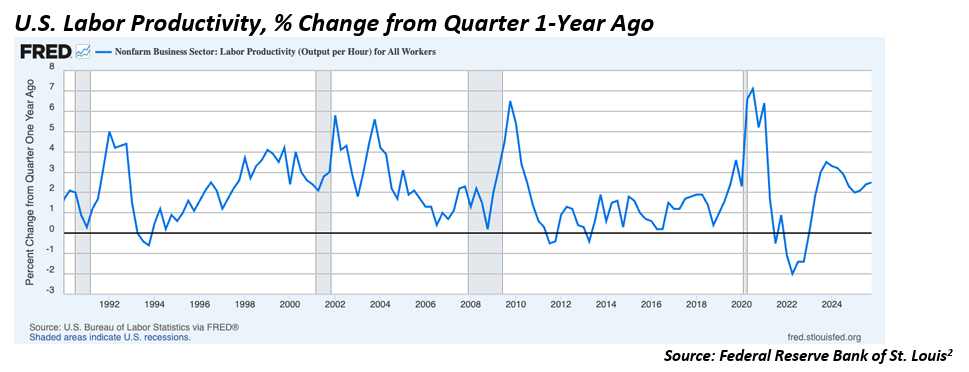
To be sure, I still think Warsh will make the case for lower interest rates. His argument will likely be that the recent oil shock is a supply-side issue, not evidence of demanddriven inflation. He may also point to improving productivity as a disinflationary force, especially if artificial intelligence and other technologies allow businesses to produce more output with fewer cost pressures. In the 1990s, stronger productivity growth helped the economy grow at a healthy pace without generating the kind of inflation that might otherwise have forced the Fed into a more restrictive stance. If productivity is rising again, which it currently is (see chart below), Warsh may argue that the Fed should not focus only on backward-looking inflation data.

Warsh may be more inclined to look through supply-driven inflation, but the committee may not be ready to do the same. And in my view, that’s not necessarily a negative. If growth remains positive, earnings continue to expand, and inflation does not accelerate materially, stocks do not necessarily need Fed cuts to move higher.

Bottom Line for Investors

The Fed’s decision to pause rate cuts was expected, but the bigger story is the policy environment taking shape for the rest of 2026 and beyond. A Warsh-led Fed may bring a different framework to monetary policy, with more attention paid to productivity, supply-driven inflation, and the size of the Fed’s balance sheet. Worries about collapsing Fed independence or a Fed doing the bidding of the executive branch are overblown, in my view. The Fed remains a committee-driven institution, and many voting members will likely want clearer evidence that inflation is moving back toward target before easing policy.

For investors, the key point right now is that markets appear to have already adjusted to the possibility of no rate cuts this year. That lowers the risk that a prolonged pause becomes a major negative surprise. In my view, the next phase of Fed policy may be less about whether the Fed cuts by 25-basis points, and more about how it manages liquidity, inflation expectations, and the long end of the yield curve.

1 CNBC. April 30, 2026. https://www.cnbc.com/2026/04/30/pce-inflation-rate-march-2026.html

2 Fred Economic Data. 2026.

3 Wall Street Journal. May 4, 2026. https://www.wsj.com/articles/the-great-110-trillion-wealthtransfer-wont-happen-any-time-soon-e8b2ef31

4 Wall Street Journal. May 3, 2026. https://www.wsj.com/economy/global/global-economy-iranenergy-abd8828f?mod=economy_lead_pos4

DISCLOSURE
Past performance is no guarantee of future results. Inherent in any investment is the potential for loss.

Zacks Investment Management, Inc. is a wholly-owned subsidiary of Zacks Investment Research. Zacks Investment Management is an independent Registered Investment Advisory firm and acts as an investment manager for individuals and institutions. Zacks Investment Research is a provider of earnings data and other financial data to institutions and to individuals.

This material is being provided for informational purposes only and nothing herein constitutes investment, legal, accounting or tax advice, or a recommendation to buy, sell or hold a security. Do not act or rely upon the information and advice given in this publication without seeking the services of competent and professional legal, tax, or accounting counsel. Publication and distribution of this article is not intended to create, and the information contained herein does not constitute, an attorney-client relationship. No recommendation or advice is being given as to whether any investment or strategy is suitable for a particular investor. It should not be assumed that any investments in securities, companies, sectors or markets identified and described were or will be profitable. All information is current as of the date of herein and is subject to change without notice. Any views or opinions expressed may not reflect those of the firm as a whole.

Any projections, targets, or estimates in this report are forward looking statements and are based on the firm’s research, analysis, and assumptions. Due to rapidly changing market conditions and the complexity of investment decisions, supplemental information and other sources may be required to make informed investment decisions based on your individual investment objectives and suitability specifications. All expressions of opinions are subject to change without notice. Clients should seek financial advice regarding the appropriateness of investing in any security or investment strategy discussed in this presentation.

Certain economic and market information contained herein has been obtained from published sources prepared by other parties. Zacks Investment Management does not assume any responsibility for the accuracy or completeness of such information. Further, no third party has assumed responsibility for independently verifying the information contained herein and accordingly no such persons make any representations with respect to the accuracy, completeness or reasonableness of the information provided herein. Unless otherwise indicated, market analysis and conclusions are based upon opinions or assumptions that Zacks Investment Management considers to be reasonable.

Any investment inherently involves a high degree of risk, beyond any specific risks discussed herein.

It is not possible to invest directly in an index. Investors pursuing a strategy similar to an index may experience higher or lower returns, which will be reduced by fees and expenses.

The ICE U.S. Dollar Index measures the value of the U.S. Dollar against a basket of currencies of the top six trading partners of the United States, as measured in 1973: the Euro zone, Japan, the United Kingdom, Canada, Sweden, and Switzerland. An investor cannot directly invest in an index. The volatility of the benchmark may be materially different from the individual performance obtained by a specific investor.

Zacks Investment Management, Inc. is a wholly-owned subsidiary of Zacks Investment Research. Zacks Investment Management is an independent Registered Investment Advisory firm that acts as an investment manager for individuals and institutions. Zacks Investment Research is a provider of earnings data and other financial data to institutions and to individuals.

This material is being provided for informational purposes only and nothing herein constitutes investment, legal, accounting or tax advice, or a recommendation to buy, sell or hold a security. Do not act or rely upon the information and advice given in this publication without seeking the services of competent and professional legal, tax, or accounting counsel. Publication and distribution of this article is not intended to create, and the information contained herein does not constitute, an attorney-client relationship. No recommendation or advice is being given as to whether any investment or strategy is suitable for a particular investor. It should not be assumed that any investments in securities, companies, sectors or markets identified and described were or will be profitable. All information is current as of the date of herein and is subject to change without notice. Any views or opinions expressed may not reflect those of the firm as a whole.

Any projections, targets, or estimates in this report are forward looking statements and are based on the firm’s research, analysis, and assumptions. Due to rapidly changing market conditions and the complexity of investment decisions, supplemental information and other sources may be required to make informed investment decisions based on your individual investment objectives and suitability specifications. All expressions of opinions are subject to change without notice. Clients should seek financial advice regarding the appropriateness of investing in any security or investment strategy discussed in this presentation.

Certain economic and market information contained herein has been obtained from published sources prepared by other parties. Zacks Investment Management does not assume any responsibility for the accuracy or completeness of such information. Further, no third party has assumed responsibility for independently verifying the information contained herein and accordingly no such persons make any representations with respect to the accuracy, completeness or reasonableness of the information provided herein. Unless otherwise indicated, market analysis and conclusions are based upon opinions or assumptions that Zacks Investment Management considers to be reasonable. Any investment inherently involves a high degree of risk, beyond any specific risks discussed herein.

The S&P 500 Index is a well-known, unmanaged index of the prices of 500 large-company common stocks, mainly blue-chip stocks, selected by Standard & Poor’s. The S&P 500 Index assumes reinvestment of dividends but does not reflect advisory fees. The volatility of the benchmark may be materially different from the individual performance obtained by a specific investor. An investor cannot invest directly in an index. The Russell 1000 Growth Index is a well-known, unmanaged index of the prices of 1000 large-company growth common stocks selected by Russell.

The Russell 1000 Growth Index assumes reinvestment of dividends but does not reflect advisory fees. An investor cannot invest directly in an index. The volatility of the benchmark may be materially different from the individual performance obtained by a specific investor.

Nasdaq Composite Index is the market capitalization-weighted index of over 3,300 common equities listed on the Nasdaq stock exchange. The types of securities in the index include American depositary receipts, common stocks, real estate investment trusts (REITs) and tracking stocks, as well as limited partnership interests. The index includes all Nasdaq-listed stocks that are not derivatives, preferred shares, funds, exchange-traded funds (ETFs) or debenture securities. An investor cannot invest directly in an index. The volatility of the benchmark may be materially different from the individual performance obtained by a specific investor.

The Dow Jones Industrial Average measures the daily stock market movements of 30 U.S. publicly-traded companies listed on the NASDAQ or the New York Stock Exchange (NYSE). The 30 publicly-owned companies are considered leaders in the United States economy. An investor cannot directly invest in an index. The volatility of the benchmark may be materially different from the individual performance obtained by a specific investor.

The Bloomberg Global Aggregate Index is a flagship measure of global investment grade debt from twenty-four local currency markets. This multi-currency benchmark includes treasury, government-related, corporate and securitized fixed-rate bonds from both developed and emerging markets issuers. An investor cannot invest directly in an index. The volatility of the benchmark may be materially different from the individual performance obtained by a specific investor.

The ICE Exchange-Listed Fixed & Adjustable Rate Preferred Securities Index is a modified market capitalization weighted index composed of preferred stock and securities that are functionally equivalent to preferred stock including, but not limited to, depositary preferred securities, perpetual subordinated debt and certain securities issued by banks and other financial institutions that are eligible for capital treatment with respect to such instruments akin to that received for issuance of straight preferred stock. An investor cannot invest directly in an index. The volatility of the benchmark may be materially different from the individual performance obtained by a specific investor.

The CBOE Volatility Index (VIX) is a calculation designed to produce a measure of constant, 30-day expected volatility of the U.S. stock market, derived from real-time, mid-quote prices of S&P 500 Index call and put options. On a global basis, it is one of the most recognized measures of volatility — widely reported by financial media and closely followed by a variety of market participants as a daily market indicator. The volatility of the benchmark may be materially different from the individual performance obtained by a specific investor. An investor cannot invest directly in an index. The NASDAQ-100 Index includes 100 of the largest domestic and international non-financial companies listed on The NASDAQ Stock Market based on market capitalization. The Index reflects companies across major industry groups including computer hardware and software, telecommunications, retail/wholesale trade and biotechnology. Index composition is reviewed on an annual basis in December. An investor cannot invest directly in an index.
Mitch Zacks – Weekly Market Commentary: Fixed Income Investments Now Offer More Opportunities

By Weekly Market Commentary

The first quarter of 2026 brought many interesting developments for bond investors. Renewed inflation concerns pushed yields higher, reversing early gains and leaving the Bloomberg U.S. Aggregate Bond Index slightly negative for the quarter. At the same time, expectations for Federal Reserve rate cuts shifted meaningfully, with the probability of a cut falling to roughly 37%, down from 72% at the end of 2025.

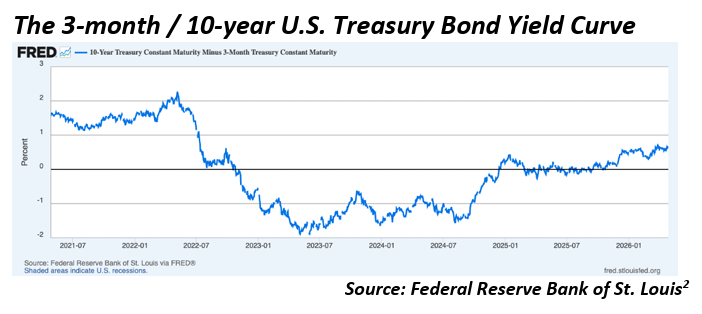
Taken together, these developments drove a notable move in Treasury yields. The 10-year yield rose as high as 4.44% before ending March at 4.32%, while the 2-year climbed to 4.00% before settling near 3.80%.1 Short-term yields rose faster than long-term yields, flattening the curve modestly, though it remains slightly upward sloping (in the chart below, data points above 0 represent an upward sloping yield curve).

While rising yields pressured bond prices, they also improved something largely missing from fixed income for much of the past decade: income. Today’s yields are meaningfully higher than in the post-2010 period, and a larger share of expected returns is now coming from income rather than price appreciation. That shift suggests bonds may once again serve a more traditional role in portfolios, not only as an instrument for reducing overall volatility but also as a source of steady cash flow. In my view, this means investors who have been content with cash (money market) returns in past years may want to give the bond market a closer look. In 2025, broad fixed income returned roughly 7.3%, compared to about 4.3% for cash, marking the first time in several years that bonds meaningfully outperformed. 3 This outperformance reflects both higher starting yields and a gradual steepening in the yield curve, where extending beyond cash is once again being rewarded.

The macro backdrop also appears to be evolving in a way that could support the income story. While headline inflation has moved higher, much of the pressure has been driven by energy prices. Beneath the surface, core inflation remains more contained (2.6% in March), and longer-term expectations have stayed relatively anchored. Meanwhile, we know the labor market is the weak link in the Fed’s inflation/labor mandate. The unemployment rate has risen to approximately 4.3% as of March 2026, up from a 3.4% low in 2023, with hiring trends becoming increasingly uneven. March payrolls rose by +178,000, but in February was revised to -133,000, underscoring volatility in the data.4 If we look more broadly at annual monthly job gains, we can see a stark and steady weakening pattern, which I have argued before likely means a bias towards more cuts in 2026.

For bond investors, this combination is important. Stable underlying inflation helps preserve the real value of income, while signs of a cooling labor market, I think, rule out the possibility of further policy tightening. In practical terms, that means less upward pressure on yields and a more supportive backdrop for bond prices.

Finally, a quick note on the municipal bond market outlook from here. Rising Treasury yields have pushed municipal yields higher as well, improving their relative attractiveness, particularly for investors in higher tax brackets. The yield curve remains slightly upward sloping, and while valuations have not changed dramatically, income levels are more compelling than they were just a few years ago. At the same time, fiscal conditions for state and local governments remain stable, supporting the overall credit backdrop. As a result, municipals continue to serve as a useful tool for tax-efficient income within a diversified fixed income allocation.

Bottom Line for Investors

After years when cash looked unusually competitive and bonds offered limited yield, investors now have more ways to be compensated for taking measured fixed income risk. For investors with cash that is not needed in the near term, but that you still want to treat conservatively, this may be an opportunity to reassess whether staying on the sidelines still offers the best risk/reward tradeoff. Because today’s fixed market offers income that can contribute meaningfully to total return while still playing a stabilizing role in portfolios.

1Wall Street Journal. 2026. https://www.wsj.com/world/middle-east/u-a-e-opec-new-middle-east32ceda56?mod=Searchresults&pos=1&page=1

2 Wall Street Journal. April 30, 2026. https://www.wsj.com/economy/central-banking/u-s-economygrew-at-2-rate-in-first-quarter-6e0c18cc?mod=economy_lead_story

3 Financial Post. April 29, 2026. https://financialpost.com/pmn/business-pmn/us-core-capital-goodsorders-jump-by-most-since-2020

DISCLOSURE
Past performance is no guarantee of future results. Inherent in any investment is the potential for loss.

Zacks Investment Management, Inc. is a wholly-owned subsidiary of Zacks Investment Research. Zacks Investment Management is an independent Registered Investment Advisory firm and acts as an investment manager for individuals and institutions. Zacks Investment Research is a provider of earnings data and other financial data to institutions and to individuals.

This material is being provided for informational purposes only and nothing herein constitutes investment, legal, accounting or tax advice, or a recommendation to buy, sell or hold a security. Do not act or rely upon the information and advice given in this publication without seeking the services of competent and professional legal, tax, or accounting counsel. Publication and distribution of this article is not intended to create, and the information contained herein does not constitute, an attorney-client relationship. No recommendation or advice is being given as to whether any investment or strategy is suitable for a particular investor. It should not be assumed that any investments in securities, companies, sectors or markets identified and described were or will be profitable. All information is current as of the date of herein and is subject to change without notice.

Any views or opinions expressed may not reflect those of the firm as a whole. Any projections, targets, or estimates in this report are forward looking statements and are based on the firm’s research, analysis, and assumptions. Due to rapidly changing market conditions and the complexity of investment decisions, supplemental information and other sources may be required to make informed investment decisions based on your individual investment objectives and suitability specifications. All expressions of opinions are subject to change without notice. Clients should seek financial advice regarding the appropriateness of investing in any security or investment strategy discussed in this presentation.

Certain economic and market information contained herein has been obtained from published sources prepared by other parties. Zacks Investment Management does not assume any responsibility for the accuracy or completeness of such information. Further, no third party has assumed responsibility for independently verifying the information contained herein and accordingly no such persons make any representations with respect to the accuracy, completeness or reasonableness of the information provided herein. Unless otherwise indicated, market analysis and conclusions are based upon opinions or assumptions that Zacks Investment Management considers to be reasonable.

Any investment inherently involves a high degree of risk, beyond any specific risks discussed herein.

It is not possible to invest directly in an index. Investors pursuing a strategy similar to an index may experience higher or lower returns, which will be reduced by fees and expenses.

The ICE U.S. Dollar Index measures the value of the U.S. Dollar against a basket of currencies of the top six trading partners of the United States, as measured in 1973: the Euro zone, Japan, the United Kingdom, Canada, Sweden, and Switzerland. An investor cannot directly invest in an index. The volatility of the benchmark may be materially different from the individual performance obtained by a specific investor. Zacks Investment Management, Inc. is a wholly-owned subsidiary of Zacks Investment Research.

Zacks Investment Management is an independent Registered Investment Advisory firm that acts as an investment manager for individuals and institutions. Zacks Investment Research is a provider of earnings data and other financial data to institutions and to individuals.

This material is being provided for informational purposes only and nothing herein constitutes investment, legal, accounting or tax advice, or a recommendation to buy, sell or hold a security. Do not act or rely upon the information and advice given in this publication without seeking the services of competent and professional legal, tax, or accounting counsel. Publication and distribution of this article is not intended to create, and the information contained herein does not constitute, an attorney-client relationship. No recommendation or advice is being given as to whether any investment or strategy is suitable for a particular investor. It should not be www.zacksim.com | 6 Mitch on the Markets Weekly Client Commentary | April 30, 2026 assumed that any investments in securities, companies, sectors or markets identified and described were or will be profitable. All information is current as of the date of herein and is subject to change without notice. Any views or opinions expressed may not reflect those of the firm as a whole.

Any projections, targets, or estimates in this report are forward looking statements and are based on the firm’s research, analysis, and assumptions. Due to rapidly changing market conditions and the complexity of investment decisions, supplemental information and other sources may be required to make informed investment decisions based on your individual investment objectives and suitability specifications. All expressions of opinions are subject to change without notice. Clients should seek financial advice regarding the appropriateness of investing in any security or investment strategy discussed in this presentation.

Certain economic and market information contained herein has been obtained from published sources prepared by other parties. Zacks Investment Management does not assume any responsibility for the accuracy or completeness of such information. Further, no third party has assumed responsibility for independently verifying the information contained herein and accordingly no such persons make any representations with respect to the accuracy, completeness or reasonableness of the information provided herein. Unless otherwise indicated, market analysis and conclusions are based upon opinions or assumptions that Zacks Investment Management considers to be reasonable. Any investment inherently involves a high degree of risk, beyond any specific risks discussed herein.

The S&P 500 Index is a well-known, unmanaged index of the prices of 500 large-company common stocks, mainly blue-chip stocks, selected by Standard & Poor’s. The S&P 500 Index assumes reinvestment of dividends but does not reflect advisory fees. The volatility of the benchmark may be materially different from the individual performance obtained by a specific investor. An investor cannot invest directly in an index. The Russell 1000 Growth Index is a well-known, unmanaged index of the prices of 1000 large-company growth common stocks selected by Russell.

The Russell 1000 Growth Index assumes reinvestment of dividends but does not reflect advisory fees. An investor cannot invest directly in an index. The volatility of the benchmark may be materially different from the individual performance obtained by a specific investor.

Nasdaq Composite Index is the market capitalization-weighted index of over 3,300 common equities listed on the Nasdaq stock exchange. The types of securities in the index include American depositary receipts, common stocks, real estate investment trusts (REITs) and tracking stocks, as well as limited partnership interests. The index includes all Nasdaq-listed stocks that are not derivatives, preferred shares, funds, exchange-traded funds (ETFs) or debenture securities. An investor cannot invest directly in an index. The volatility of the benchmark may be materially different from the individual performance obtained by a specific investor.

The Dow Jones Industrial Average measures the daily stock market movements of 30 U.S. publicly-traded companies listed on the NASDAQ or the New York Stock Exchange (NYSE). The 30 publicly-owned companies are considered leaders in the United States economy. An investor cannot directly invest in an index. The volatility of the benchmark may be materially different from the individual performance obtained by a specific investor.

The Bloomberg Global Aggregate Index is a flagship measure of global investment grade debt from twenty-four local currency markets. This multi-currency benchmark includes treasury, government-related, corporate and securitized fixed-rate bonds from both developed and emerging markets issuers. An investor cannot invest directly in an index. The volatility of the benchmark may be materially different from the individual performance obtained by a specific investor.

The ICE Exchange-Listed Fixed & Adjustable Rate Preferred Securities Index is a modified market capitalization weighted index composed of preferred stock and securities that are functionally equivalent to preferred stock including, but not limited to, depositary preferred securities, perpetual subordinated debt and certain securities issued by banks and other financial institutions that are eligible for capital treatment with respect to such instruments akin to that received for issuance of straight preferred stock. An investor cannot invest directly in an index. The volatility of the benchmark may be materially different from the individual performance obtained by a specific investor.

The CBOE Volatility Index (VIX) is a calculation designed to produce a measure of constant, 30-day expected volatility of the U.S. stock market, derived from real-time, mid-quote prices of S&P 500 Index call and put options. On a global basis, it is one of the most recognized measures of volatility — widely reported by financial media and closely followed by a variety of market participants as a daily market indicator. The volatility of the benchmark may be materially different from the individual performance obtained by a specific investor. An investor cannot invest directly in an index. The NASDAQ-100 Index includes 100 of the largest domestic and international non-financial companies listed on The NASDAQ Stock Market based on market capitalization. The Index reflects companies across major industry groups including computer hardware and software, telecommunications, retail/wholesale trade and biotechnology. Index composition is reviewed on an annual basis in December. An investor cannot invest directly in an index.